

BY MARÍA PILAR PARENTE AND ROBERTO CARLOS MIRAS MIRAS
Thursday 13 December 2018
With these words Rudyard Kipling titled (1865-1936) a text which was censored in Spain and has been published some time ago by Editorial Pre-textos with an introduction and translation by Álvaro García. All authors at some point in their life in a biography or in a novel, as happened to Kipling, tell something about what has happened to them and this sometimes manages to overcome the so-called time barrier..
And as Lama Kiabye Khensur Tamding Gyatso Rimpoche has written (1926-2002) «Buddhism teaches us to be less egocentric and more compassionate, affectionate and attentive towards others. Our daily thoughts and actions should be directed toward the benefit of others.. The more we familiarize our mind with spiritual training, the calmer and more peaceful it becomes.» That is why sometimes we use the word Tribute to what has happened and other times we use another word that is also very overused Human Rights. We live, as Professor Alberto Maestre Fuentes points out in his work, surrounded by interests and they are not interested in the people or the aforementioned Human Rights.. How Maestre did at work «An abandoned town. The deceptions in the decolonization of Western Sahara» we wonder.
¿WHAT ARE WE REALLY TALKING ABOUT??
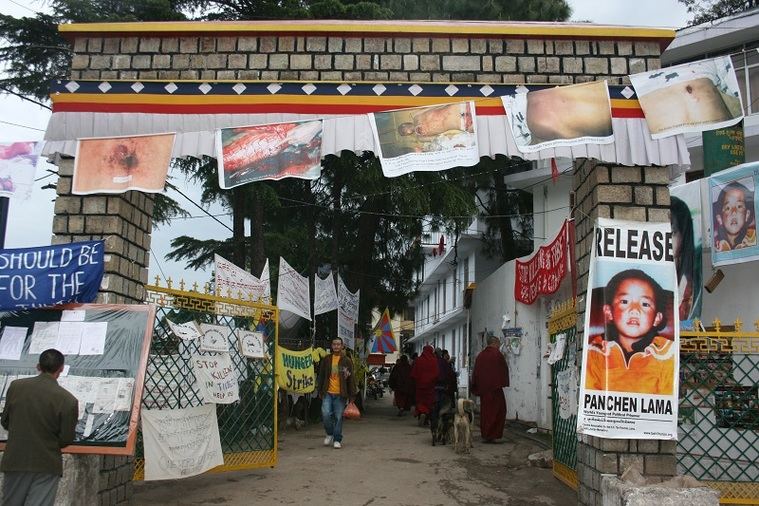
Not long ago, in a conversation with the young scholars Jordi Carot and José Saenz de Heredía, authors of a Great Documentary on the topic of Tibet, his name came up again. We had already read a text of his published at the time. Talk about Palden Gyatso (1933-2018) and his work «Fire under the snow. Memoirs of a prisoner» It makes us go backwards but as the current Dalai Lama would say «We must understand the past to find solutions for the future» Lama Palden Gyatso was born in a village called Panam, two hundred kilometers from the capital of Tibet, and in the aforementioned work he recorded what happened to a young man who only wanted to live in freedom.. He was arrested for protesting and passed 33 years in prisons and forced camps in China where he was tortured and escaped from China, going into exile in Dharamsala in Northern India until the time of his death arrived.. But like many other cases, there was no resentment or hatred in his words, but rather a knowledge and wisdom that, as they have said, occurred when meeting him.. Buddhism came to Tibet in 1950. However, the Chinese authorities have considered it part of their territory for centuries due to dynastic unions and conquests in the imperial era.. But the Tibetan exile emphasizes that it was independent until it was occupied by the communist regime in the 1970s. 1950. It is estimated that there are some 600.000 Chinese soldiers in Tibet which is inhabited by 6 millions of Tibetans and 8 millions of chinese. Tibetans are a minority in their own country.
SOME AUTHORS
There have been many people who have wanted to do their bit to make known both culturally and politically what is really happening or want to respond with their work to what has been called Buddhism.. In the case of the Editor and writer Agustín Pániker- an author who under the seal of Kairós- has published various works and now surprises us with his «The three jewels. The Buddha, His Teaching and the Community» where to write his work he seems to have «interviewed» with Buddha himself. Or the monograph made by the translator and philosopher Fernando Mora talking about Buddhism but under the common thread of «Padmsambhava and Tibetan Buddhism» Perhaps, as one writer author of «Viaje al mundo de Nisargadatta Maharaj» These works are necessary to avoid losing that line of disciples that with the passage of time ends up being lost and forgotten..
Let's get back to our topic, to that concern with which we have begun to write this column.
A LITTLE HISTORY
As Professor Vicente Merlo would say ¿what we call the fascination of the East?. Many speak of suffering and it has truly accompanied the Tibetan people to this day.. As Palden Gyatso did at the time, many Tibetans have denounced the atrocities committed with a sign of peace. «An immense laboratory of torture techniques for the Chinese Armed Forces» This is how the Asia Watch organization described the situation in Tibet in 1990. Many years of colonization have brought the highest country in the world with two thousand years of history to the brink of annihilation.. In recent years the Chinese have changed their strategy in Tibet: In addition to military repression, it is increasingly relying on the racial and economic colonization of this vast territory.. Many monks and nuns have protested by burning themselves in different Chinese provinces.. In total, the count of Buddhist monks and Tibetan laymen who have set themselves on fire since the year 2009 exceeds one hundred. Many of them have died from burns.. And it was a few years ago when the journalist and traveler Thomas Laird, who lives between Kathmandu and New Orleans and who has recently been in our country, published a monumental work that enriches the oral tradition of Tibet to offer us a broader and deeper vision of the country with his work. «The History of Tibet. Conversations with the Dalai Lama»
¿AND FAR FROM TIBET?
«May each of you be your own island, each his own refuge, without trying to embrace anyone else. May each of you have the teaching per island, have teaching as a refuge, without trying to embrace any other» (Shortly before dying Buddha remembered his disciples)
There are places that are far away but have remained in the heart and this is what our protagonist must have thought when he came to live in Spain and having visited other places around the Globe.. Thubten Wangchen was born in 1954 and at the age of five he had to leave his country. His father carried him on his shoulders and held his older sister by the hand. He survived by begging on the streets of Kathmandu like many other Tibetans. «If the Chinese saw a Tibetan move, they declared against him» His life is already sufficiently known and has appeared in different media, both written and visual, but something was missing.… And it is now that, with the collaboration of Professor María Teresa Pous Mas, she has published «a little story of his life» A testimonial book from the first to the last page telling what happened to him from the first moment he came into contact with life.
When asked about the censorship that is exercised in China against foreign media, he answers «They only teach the beautiful, the beautiful. They only want to give pro-communist information, they hide the torture, human rights violations and the abandonment of girls in the streets» In your «Far from Tibet. Her life and thoughts explained to María Teresa Pous More» We find a figure that appears on all the pages of the book and is extremely important for the author., We talk about His Holiness the current Dalai Lama as well as the different companions who have formed and are part of this man who is a Buddhist monk. ¿How were your beginnings??, ¿How he studied a language that was not his own? If it were not for a belief or philosophy such as the Buddhist one, we are facing a man like there have been many and many who have made the obstacle a virtue..
It is a book of encounters and disagreements like life itself where we have friends, cousins and people of exceptional human quality because we do not have them. It has rained a lot since his birth until today and there have been many disappointments and joys that have surrounded him, such as the creation of a Meeting House in Barcelona that they have called The House of Tibet or his numerous trips to Dharamsala among other places when there was no money for it with a message based entirely perhaps on the experience of the encounter with the other., with the one in front of him. Surrounded, yes indeed, of a Buddhist Philosophy that has increasing interest in our country. But if there is something to highlight, it is not only the figure of Thubten Wangchen but also that of many women and many men who, when faced with problems, in the end everything has a solution..
someone once said: «Between men and women we have disagreements and encounters but we look at the sky and that disappears» It is the life of Thubten Wangchen, a Tibetan monk, director of the House of Tibet in Barcelona., but maybe it could be the life of any of us.


