

Human rights
The massacre of 10 March 1959
Commemoration of the anniversary of the uprising of the Tibetan people
He 10 March 1959 A gigantic peaceful demonstration spontaneously arose in the streets of Lhasa, where the independence of Tibet and the end of Chinese repression were called for, It was brutally crushed by the Chinese.; it is estimated that 87.000 Tibetans died.
The Dalai Lama and his family had to disguise themselves to escape from the Chinese troops. He 28 March of that year, Chinese Zhou Enlai announced that Tibet was under Chinese control. Shortly after, the Chinese appointed the Panchen Lama head of state.. The Dalai Lama crossed the border with about 100.000 Tibetans. They settled in Dharamsala, north of India, where they set up the new government in exile, as well as the seat of the Dalai Lama's personal monastery, el Namgyal.
The Indian government offered land in the state of Karnataka (at South of that country), where there are currently about 10.000 exiles and where new headquarters for the Drepung monasteries were built, Sera and Ganden.The 21 October, The United Nations Assembly passed a resolution deploring the suppression of human rights in Tibet. He 9 March 1961 a similar resolution was passed.
in 1962 a part of the Chinese Communist Party demanded that the Panchen Lama classify the Dalai Lama as “reactionary and traitor”. However, the Panchen Lama sent a document to the Chinese authorities describing the systematic destruction that Tibet was suffering.. Shortly afterward the Panchen Lama was imprisoned and would only be released in 1977.
in 1965 Tibet was formally converted into a region of the People's Republic of China and Beijing announced that the region should undergo a firm socialist transformation.. During the Cultural Revolution, The Maoist Red Guard intensified anti-religious persecution and destroyed thousands of Buddhist monasteries and monuments..
At the end of the decade 1970, after the end of the Cultural Revolution, China gradually eased its Tibet policy. In between 1979 and 1984, The Dalai Lama sent two delegations to Beijing, trying to reach an agreement. These conversations did not come to anything concrete since, the Chinese, They only wanted to discuss the Dalai Lama's return to Tibet and not human rights issues., legal situation, repression, etc.
The Chinese admitted 1980 that Tibet had been badly governed and announced reforms in the region, They allowed religious activities and rebuilt some monasteries destroyed by the Red Guard in an effort to improve their relations with the Tibetan people..
In October 1987 and May 1993 There were violent protest demonstrations against the Chinese government, Chinese authorities responded with several measures such as violent repression of dissent, the severe supervision of religious activity and the immigration of Han Chinese settlers to outnumber the native population.
He 24 of January of 1989 The Panchen Lama condemned the Chinese invasion saying that it had brought “more destruction than benefits”; Four days later he died of an alleged “heart attack”. A few days later his teacher and some family members also died victims of a “heart attack”. In March, China imposed martial law and, A few months later the massacre of Chinese students occurred in Beijing. That same year, The Dalai Lama received the Nobel Peace Prize, from that very moment, harshly criticized and insulted by the Chinese government. (Both the Dalai Lama and the person who had been awarded the prize). In August 1993 Talks were held between the Chinese and representatives of the Dalai Lama, although they did not achieve substantial changes in Chinese policy.
The flag of Tibet
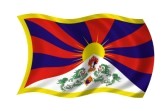 The Tibetan national flag, one of the symbols banned by the Chinese authorities, It is closely connected with the surnames of Tibet and is thousands of years old..
This version of the Tibet flag was introduced in 1912 by S. S. the Thirteenth Dalai Lama, Tubten Gyatso (1875-1933), being the official flag of Tibet prior to the Chinese invasion of 1950.
Its meaning
- The white triangle, representing a mountain of snow, symbolizes the Tibetan nation known as “the earth surrounded by mountains of snow”.
- The six red rays symbolize the six original Tibetan tribes.; alternating with blue rays that symbolize their protective divinities.
- The Sun symbolizes Freedom and Happiness.
- The two snow lions symbolize the Tibetan men and women protecting the three jewels of the Buddhist refuge.: Buda, His teachings (Dharma) and your community (Sangha).
- The two-color circular symbol symbolizes the balance between body and mind.
- The yellow border, optional, symbolizes the flourishing of Buddhism in all directions.
The anthem of Tibet (Gyallu)
Gyallu is the national anthem of Tibet and focuses on the radiance of Buddha. The text was written by Venerable Trijang Rinpoche around 1950, but it is not clear exactly when the modern hymn of Tibet was first used., either while the country was still under the control of the Dalai Lama or in the first administration of the government-in-exile, after the invasion by China.
The first news of a hymn (presumably this) It is from the time of 1949 a 1950 (when the country was already facing the threat of a Chinese invasion) and was presented within the framework of reforms that had been implemented to strengthen the patriotic sentiment of the Tibetan people. Another report states that the anthem was presented in the 14 º Dalai Lama en 1960, after he was exiled.
Regardless of the date of adoption of the aforementioned anthem, The melody is said to be based on a very ancient piece of sacred music from Tibet., and the handwriting is from the tutor of His Holiness the Dalai Lama, Venerable Trijang Rinpoche.
This anthem has been used by Tibetans in exile since its approval, but it is strictly prohibited to be used within the Tibet Autonomous Region, under penalty of death.
The lyrics of the Tibetan Hymn
Gyallu
Si Zhi Phen De Dö Gu Jungwae Ter
Thubten Samphel Norbue Onang Bar.
Tendroe Nordzin Gyache Kyongwae Gön,
Trinley Kyi Rol Tsö Gye,
Dorje Khamsu Ten Pey,
Chogkun Jham Tse Kyong,
Namkö Gawa Gyaden,
ü-Phang Gung la Regh
Curse Dezhii Nga-Thang Gye
The Hungry Hair,
Sum Gyi Khyon La
Dekyi Dzogden Sarpe Khyap.
Which hair and clothes did you choose?
Thubten Chog Chur Gyepe
Dzamling Yangpae Kyegu
Zhidae Pel La Jör.
Bhöd Jong Tendro Getzen Nyi-o-Kyi
Trashy O-Your Butterfly Zi,
Nag Chog Goodfeet Yul Ley,
Gyal Gyur Chig.
Spanish translation of the Tibetan Hymn
Gyallu
As a treasure that grants all wishes of happiness and benefit,
let the word of the Buddha rise, like a shining diamond.
Oh Protectors!, You who watch over the immense kingdom of
Doctrine and beings, that you can spread your love
and compassion, like ocean, about the world and the universe.
May the head of the Emperor, crowned with one hundred truths,
reach the zenith and cover with infinite joy and happiness
the whole of the three Tibetan provinces, for
May the prestigious glory of spiritual and temporal power radiate.
May the Buddha's teaching radiate in the ten directions
and may it bring happiness and peace to all beings in the universes.
May the qualities of the Doctrine and the people of Tibet
shine like a sun with a hundred thousand beneficent rays.
May his brilliant power be victorious in combat
against dark ignorance and keep forever
the independence of Tibet.
Gendun Choekyi Yourself
11th Panchen Lama of Tibet
Gedun Choekyi My mind wasn't there 6 years when the Chinese government kidnapped him and his family a few days after being called the 11th Panchen Lama by His Holiness. the Dalai Lama.
This happened in 1995 and made Gendun Choekyi Nyima the youngest political prisoner in the world.
Eleven years later, although no one knows where it is or how it is located.
The title of “Panchen Lama” It is given to the spiritual leader who comes second in the hierarchy of Tibetan Buddhism, after the Dalai Lama. “Panchen” It is a word that comes from the Sanskrit term “Pandita”: sage, and from Tibetan “chenpo”: grande. According to the Tibetans, the Panchen Lama are the emanations of the Buddha Amitabha, the Buddha of Infinite Light. They have no political responsibilities, although they are in charge of directing the search for the new Dalai Lama.
He 14 May 1995, after six years of investigations and consultations, SS. The Dalai Lama announced that he had found the new Panchen Lama: Gendun Choekyi Yourself, born on 25 April 1989 in the town of Lhari (Tibet). The new Panchen Lama, from a humble family, He passed all the tests he was subjected to for verification as the eleventh reincarnation of the Panchen Lama.
He 17 of May, three days after its proclamation, Gendun and his family disappeared. For a year, The Chinese government did not want to give any information about where the child and his parents were.. He 28 May 1996, the official Chinese news agency Xinhua announced that Gendun was “under government protection at the request of his parents, due to the risk of being kidnapped by separatists”. Actually, he 17 May 1995 a special group of the chinese army, in a surprise operation and with the landing of numerous helicopters in the village of Gendun, He managed to kidnap the little lama and take him to an unknown place within Chinese territory..
He 29 November 1996 The Chinese government annulled the appointment of the Panchen Lama made by SS. the Dalai Lama and, at the same time, announced his own appointment to the position of Panchen Lama in the person of Gyaltsen Norbu, a boy of the same age as in Gendun and who, randomly, He was the son of a member of the Chinese Communist Party.
You will find more information (in English):
www.tibet.ca/panchenlama/
(official website of the Panchen Lama)
www.tchrd.org
www.casadeltibetbcn.org
www.savetibet.org
www.tibetoffice.org
The Middle Way
Introduction to the politics of the Middle Way and its history
Published by the Department of Information and International Relations, A.C.T., Dharamsala (India)
His Holiness the Dalai Lama put forward the Middle Way Proposal to peacefully resolve the Tibet conflict and provide stability and coexistence between the Tibetan and Chinese peoples based on equality and mutual cooperation.. This is also the policy democratically adopted by the Central Tibetan Administration and the Tibetan people through a series of debates held over a long period of time.. This brief introduction to the politics of the Middle Way and its history is addressed to the Tibetan people., inside and outside Tibet and to all people interested in this topic, to provide a better understanding of the issues involved.
Meaning of the Middle Way proposal
The Tibetan people do not accept the current situation of Tibet dominated by the People's Republic of China, but it does not intend the independence of Tibet, despite being a historical fact. The strategy lies in finding a middle ground and a system to achieve true autonomy, within the structure of the People's Republic of China, for all Tibetans living in the three provinces that traditionally made up Tibet. This is known as the Middle Way Proposal., an impartial and moderate position that safeguards the vital interests of all parties involved. For the Tibetan people it represents the protection and conservation of their culture., religion and national identity; for the chinese people, The security and territorial integrity of the homeland and for neighboring countries and other countries means having peaceful borders and international relations.
History of the Middle Way proposal
Although the Seventeen Point Agreement between the Tibetan Government and the People's Republic of China was not achieved on equal terms or mutual consent, His Holiness the Dalai Lama-in the interest of the benefit of both the Tibetan and Chinese people- in 1951 and for eight years he was doing everything possible to reach a peaceful solution with the Chinese Government. in 1959, after his arrival in the Lokha region along with the Kashag, Even then His Holiness continued his efforts to negotiate a solution with the leaders of the Chinese army.. Their attempts to comply with the terms of the Seventeen Point Agreement are comparable to the Middle Way Proposal. Unfortunately, the Chinese army unleashed a harsh military offensive in Lhasa, the capital of Tibet, and this fact convinced His Holiness the Dalai Lama that there was no longer any hope of coexistence with the Chinese Government. Under these circumstances, He had no choice but to seek refuge in India and from there, in exile, work for the freedom and happiness of all Tibetans.
Shortly after his arrival in Tezpur, (India) he 18 April 1959 His Holiness issued a statement explaining that the Seventeen Point Agreement was signed under duress and that the Chinese Government had deliberately violated the terms of the agreement.. Therefore His Holiness stated that from that day on the agreement would be considered null and void and that he would ensure the restoration of the independence of Tibet.. Since then and until 1979, The Central Tibetan Administration and the Tibetan people adopted the policy of demanding independence for Tibet.. However, The world in general has become increasingly interdependent, politically, militarily and economically. Therefore there have been great changes in the independence status of countries and nationalities.. In China there will surely also be changes and the time will come when both parties will enter into negotiations. His Holiness has long believed that to resolve the Tibet issue through negotiations, It is more convenient to change the policy of restoring Tibet's independence to a proposal that benefits both China and Tibet..
Rangzen Bracelet
 In traditional Tibetan belief, That-Mik Good Drill (Nuevo “Braided water eyes”) has the power to protect you from evil. Using the nine “eyes” in the form of an amulet, jewel or weaving them on clothing becomes a weapon against evil and demonic forces.
The design consists of black and white threads (light and darkness) interwoven forming “eyes”. The two colors represent the two protective deities of Tibet. Tibetans also believe that wearing a bracelet with the nine “eyes” on the wrist, through which the essential pulse of the body flows, gives protection against nervous disorders.
Men in Tibet diligently sew the nine “eyes” to their slings. They believe this increases the power of the sling and makes it a more effective weapon.. In fact, A sling is one of the nine ancient weapons of Dra-lha, God of War.
in 1988, led by the late Yulo Dawa Tsering (Ven. Yulo Rimpotxé), Tibetan political prisoners began to wear bracelets with the nine “eyes” to protect yourself from “evil” chinos, seen by Tibetans not only as their oppressors but also as the enemy of Dharma. It was also a silent protest against Chinese atrocities in Tibet and a mark of solidarity between them.. Without knowing this symbology, Prison guards also began to use the bracelets, maybe because they saw it as a custom “native” eccentric but harmless. But, when they realized its meaning, The prison authorities immediately banned the use. When a prisoner was found wearing the bracelet he was punished, Many were tortured and their sentences were even lengthened..
Popularly known as “Rangzen” o “Freedom Bracelet”, this symbol of resistance against oppression and their continued fight for freedom, It is used throughout the world by Tibetans and their supporters.. Use the “Rangzen Bracelet” It is a way to show that you know and care about the Tibetan people's struggle for independence..
Traditionally, the bracelet is given as a gift.
Another genocide in Tibet? *
*(Article by CARLOS PASTOR published on 26-04-2010 in El Punt Barcelona – The Point Camp de Tarragona and Terres de l'Ebre – THE Point Comarques Girona).
After sixty years of rule over Tibet, The Beijing government continues relentlessly. The Tibetan revolts of 1959, 1987 and 2008 They are preserved in memory as patriotic paradigms against the invading yoke.. Successively, China has slammed the door on any autonomy proposal. The February summit between the Dalai Lama and the US president, Barack Obama, It was like a ray of light in the middle of the darkness.. But will there be a before and after, following this meeting, for a Tibet so punished?
The American plea in defense of the Tibetan cause occurs in an atmosphere of arch-chronic paralysis in Sino-Tibetan relations and raises endless questions about the future of Tibet., as if China continues to apply there is repression, since the fateful revolt of 2008, or if the crimes of the Chinese government in this country can be classified as genocide.
Two years after the March revolt 2008, China continues the invasion obsession unperturbed. All attempts at dialogue have failed. If this meeting became a thread of hope, daily reality confirms stratospheric tension.
What will happen can only be interpreted by looking back.: What has been Chinese policy towards its colony during fifty years of rule??
After alleging the liberation of millions of slaves as a pretext to conquer Tibet, The Beijing government began a propaganda process hidden behind this false message., according to which the people demanded freedom from the Buddhist regime. While China demanded a negotiation as an epilogue to the conflict, on a dead end reef, Tibet was forced to agree to limited autonomy for some regions, and the others were subjected as Chinese provinces, formerly tibetan, and stripped of autonomy.
The fictitious autonomous policy was soon seen as a clear Sinicization, with the aspiration of neutralizing the counteroffensive and gaining territorial and popular support. With the effect of riots, riots and demonstrations everywhere.
As a culmination, he 10 March 1959 a peaceful independence demonstration 30.000 Tibetans ended in revolt. This is how the prologue of the Tibetan uprising was written, later put down by China, with the result of more than 10.000 Tibetans killed in just three days.
The revolt crushed, the Tibetan plateau was soaked in the slogan of cultural purification, consecrated to the point of extremism.
Since then, Every year Tibetans take to the streets to remember the events. The last violent episode took place in March 2008, when monks and civilians demonstrated in memory of the revolt of the 59. How it had happened then, the army suppressed the crowd, and imposed martial law until the Himalayas of violence. To the sum of innocent civilian victims, suspect lists added, housing records, arrests, confinement and torture of civilians, the decree to fly the Chinese flag on all buildings and police identification of civilians.
Monks could only leave the monastery with police permission, and they had their phones tapped. This panorama of martial law, after the revolt, was silenced by the media. Two years later, violence continues in Tibet.
Definitely, of the endemic Tibetan conflict, only one diagnosis can be made: repression. Since the invasion of 1950 until 1980, more than a million Tibetans have died. Among these citizens, 175.000 they have died in prison, until 156.000, in summary executions; 413.000, of hunger; 92.000, for torture, and 10.000, by suicide in prisons. Deprived of the right to self-determination and denied national identity, Any public demonstration of protest by Tibetans is conceived as an illegal separatist subversion, which involves arrest and imprisonment.
In the same way, any celebration and expression of Tibetan affirmation has been prohibited; Breaking these instructions leads to job loss., and in the case of monks, expulsion from the monastery. Tibetans talking to foreigners, They sing Tibetan songs or call for the return of the Dalai Lama end up imprisoned, and those who are caught with any image of the head of Tibetan Buddhism are punished with a fine of 1.000 yuan.
China sells to the international gallery a complacent Tibet that is opposed to the return of the Dalai Lama, distorting the reality of the town. Behind that is the Chinese censorship service and the United Front body. Allies of the regime, destroy all government criticism, with Chinese cinematographic and digital propaganda, even censoring anti-government websites. They add the 80.000 netizens, nationalist guerrillas, mercenaries bribed by the regime, that introduce viruses into anti-China portals. In the denied ideological freedom, informative and expressive, travel ban is added. All Tibetans have a passport ban and are prohibited from leaving China. In the same way, more of 150.000 Tibetan refugees who have evaded Chinese persecution cannot return to their country.
An attached visa is required with the entry and exit request, which includes a police investigation., with interrogation about behavior and ideology. A democratic process is adopted that conceals a string of obstacles to prevent the movement of Tibetans.. All this pushes to the exodus 3.000 evaded monthly, to destinations like India, Nepal and Bhutan. In the field of property, until the 2007 more of 60.000 Tibetan nomads have been displaced from their lands. In exchange of 500 yuan monthly for ten years. Ridiculous subsidies for the value of your property. Any attempt to claim a better reward is dismissed for fear of retaliation..
Thousands of executions take place in Tibet, silenced arrests, torture, arbitrary arrests of monks, peasants and elderly, and even the disappearance of minors, many of them tortured. And political prisoners. Tibetans give up fighting for their rights, which further encourages the abuse of power to impart terror. In parallel, The cultural revolution has involved cultural purification, religious and human, more than 6.000 temples destroyed and monks killed or imprisoned. Definitely, more than forty years of religious repression.
From the beginning, the revolution applied an open supremacy of Chinese celebrations. This policy of cultural eradication has also affected music festivals, religious debates and traditional dress. Another victim of Chinese despotism is environmental heritage. Historical memory, landscape, public space and sacred veneration have been altered with the opening of nearly 2.500 minas, and the Tibetan subsoil has become a flame of 600.000 million yuan. Ignoring the threat to the ecosystem, China hides behind unstoppable evolutionary progress. Masking the premeditated ruse of eradicating archaeological heritage, environmental, Tibetan historical and urban planning, On the one hand, the historical memory of Tibet is falsified for tourists., and on the other hand, urban and environmental heritage is destroyed with a pragmatic goal: annihilate the culture and identity of Tibet to reach K2 dominance.
Conclusion
In view of the past and present of the Tibetan landscape, we can infer a possible verdict to the question posed in the prelude to this chronicle: could be described as genocide, China's crimes? The London Charter of 1945 defined genocide this way: «Crime against humanity, murder, extermination, slavery, deportation, as well as destruction of a national group, ethnic, racial or religious; including death or injury to physical or moral integrity. "Well then, in 1960 The UN International Commission of Jurists baptized the Chinese practice as "religious genocide.".
The following data reinforce the sentence of 1960: in between 1959 and 1960 until 87.000 Tibetans were killed in central Tibet. The invasion caused the death of 5.700 tibetan soldiers, and the 2.000 Survivors were taken to concentration and forced labor camps.. If the population of Lhasa had reached 300.000 population, Today two thirds are Chinese.
in 2003 It was estimated that in historical Tibet there were 6.000.000 of Tibetans, and that non-Tibetans came to 7.500.000. in 2002 The Chinese administration in Tibet was made up of a 66% of Chinese and a 16% of Tibetans. Besides, no Tibetan cannot access high positions in the Communist Party of Tibet. We can confirm, well, that the Beijing government has perpetrated religious persecution, destroying shrines and manipulating the Buddhist image; policy, torpedoing national identity and the right to self-determination, and ethnic, annihilating Tibetan culture. The thesis corroborated, We can marry Chinese politics with genocide. The repression that began under the occupation came disguised under the banner of the avant-garde. The argument of progress has served as a pretext to legitimize the invasion. Cover-up strategy of a progressive colonization and a camouflaged genocide to make Chinese imperialism grow. This is how it has acted so far.
Have there been transformations? Yeah, economical and at the exclusive service of China. Instead, none in the field of politics. Meanwhile, the international community, victim of fear and moral amnesia in relation to the power of the greedy Chinese market, keep quiet and accept Beijing's authoritarianism. Future prospects, far from intransigence or submission to the Beijing government, They travel through peaceful channels, whether economic boycott or human spiritual and pragmatic balance. However, while China attacks rights and freedoms, erode Tibetan identity, insulte el Dalai Lama, carry out patriotic re-education campaigns and prevent the right to self-determination, will apply genocide. As long as China does not act in accordance with UN principles, any change of horizon will be impossible. Oval meetings can do little. The future is, exclusively, at the hands of China. Will he be able to change his attitude towards Tibet?? Only the political climate has the answer. The rest are mere hypotheses, bets for political lovers.
LHAKAR: White Wednesday of solidarity with Tibet
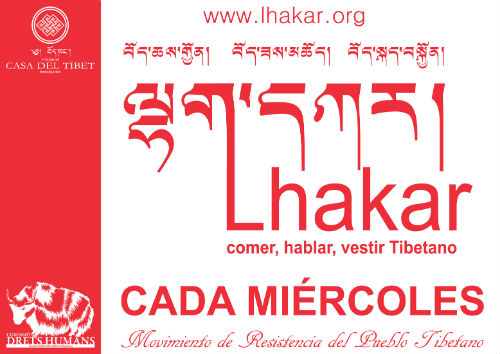

A few years ago, A popular resistance movement was born in Tibet against the growing Chinese cultural colonization.
The Wednesdays, The Tibetan population began to boycott Made in China products and carry out Tibetan affirmation actions.. This way, Tibetans do not shop in Chinese stores or go to their restaurants, They wear traditional clothing (chuba), they speak in tibetan, They listen to their music and read in their language, They don't eat meat all day and cook typical dishes from their kitchen... This simple, low-risk activism, little by little, spread throughout the territory of Tibet and, hoy, has crossed its borders. He is known by the name LHAKAR, Tibetan word that literally translates as “White Wednesday”. Wednesday is the auspicious day, favorable, del Dalai Lama.
To promote the LHAKAR movement in Catalonia, the Tibet House Foundation, from Barcelona, encourages all friends and sympathizers of the Tibetan people to carry out, the Wednesdays, solidarity actions with the Tibetan people.
What can we do?:
- Do not go to eat at Chinese food restaurants or restaurants run by Chinese.
- Do not buy products Made in China.
- Call or write to the Chinese Consulate in Barcelona or the Chinese Embassy in Madrid asking that Human Rights be respected in Tibet.
- Do not eat meat and follow a vegetarian diet.
Data of interest:
Chinese Consulate in Barcelona
Calle de Léó XIII, 34
08022 Barcelona
A loss.: 93 254 70 70
Chinese Embassy in Madrid
Arturo Soria street, 113
28043 Madrid
A loss.: 91 519 31 92
Day and hour: working Wednesdays 18 a 19 h
Place: University Square of Barcelona
Contact: admin@casadeltibetbcn.org +34 93 207 59 66 (office hours 16:30 h a 20:30 h)
Organiza: House of Tibet Foundation