

By Niharika Mandhana
TIME World
Dharamsala, 17 July 2012
PHOTO: Prakash Mathema / AFP / Getty Images
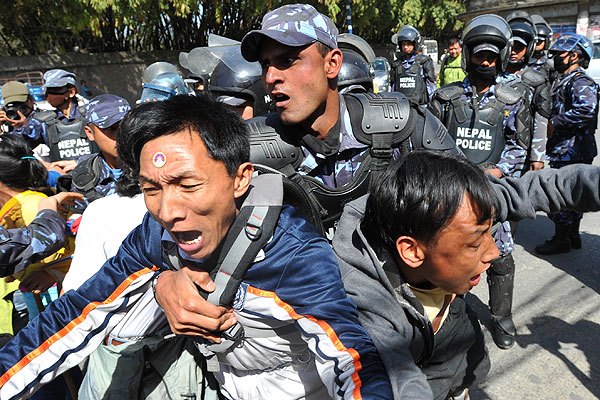
Nepal police arrest Tibetan protesters in Kathmandu, the capital, he 10 March 2012, during a demonstration for 53 anniversary of the Tibetan uprising 1959 against Chinese rule.
It’s the original (in English): As China Squeezes Nepal, Tibetan Escape Route Narrows
Tibetans seeking to escape Chinese rule are finding their traditional escape route –across the Himalayan nation of Nepal- much more tense and difficult than before
As the bus climbed towards this quiet village on the slopes of the Himalayan mountains, Tsultrim Lhamo finally felt free. For the Tibetan of 20 years fleeing his homeland under Chinese rule, his arrival in the Dalai Lama's adopted city in India, marked the end of a dangerous journey and, she hoped, the beginning of a new life.
China's growing crackdown on religious freedoms - from the imprisonment of Tibetans who own portraits of their spiritual leader to the iron-fisted control of monasteries by the Chinese military - had made life too difficult to be left behind., she says. Like others before her, she paid a Nepalese guide to lead her through the mountainous terrain that connects western China with its neighbor, Nepal. With the help of UNHCR (United Nations High Commissioner for Refugees), the UN refugee agency, she secured passage from Kathmandu to India. It was an exhausting trip that included 4 months and 3 countries. She traveled on foot, He took shelter in trees and avoided Chinese and Nepalese patrols. However, considers herself lucky. “Many people are desperate to leave Tibet” dice. “But it has become almost impossible now.”.
Since the Dalai Lama fled in 1959, Nepal has played a fundamental role for the Tibetan exile community, providing safe haven and passage to India. But in recent years, Nepalese hospitality has waned, and the reason, many say, is China's growing influence over the country's political elite.
From 2008, when an uprising rocked Lhasa ahead of the Beijing Olympics and was violently suppressed by Chinese authorities, The number of Tibetans making the trip to India has plummeted. Since the beginning of the 90 until 2007, some 2500 Tibetans were arriving in India every year. in 2008, that number fell to less than 600, and since then it has been around 800 refugees per year. A key reason, observers say, is that China has significantly tightened security, not only within Tibet but also along the border with Nepal, strangling crucial escape routes.
But China's strategy to contain Tibet's struggle for greater independence is not restricted to soldiers and hounds on its own soil.. With an eye on stopping what it calls “anti-China activities”, Beijing in recent years has gained the support of its small but strategically important neighbor, Nepal, who has received an estimate of 20 thousand Tibetan refugees and serves as a crucial transit route for those traveling to India. According to a confidential US embassy cable revealed by WikiLeaks in 2010 “Beijing has asked Kathmandu to increase patrols… and make it more difficult for Tibetans to enter Nepal”. Another cable says that China “rewards (nepalese forces) by providing incentives to officials who hand over Tibetans trying to leave China.”.
Indeed, “border management” and the exchange of information” have emerged as key areas of collaboration between the two states, with some reports claiming that Nepalese police receive training and equipment from the Chinese. At the beginning of this year, CNN journalists filming in Nepal were intercepted by plainclothes men speaking Chinese, who prevented them from using their cameras before following them when they entered Nepalese territory.
China's growing influence in Nepal has alarmed Tibetan activists and officials, who have long seen Kathmandu as a sanctuary and ally. Under an informal agreement made in 1989 between the Nepalese and the UN refugee agency, Nepal vowed to allow fleeing Tibetans to pass safely to India. Now, say the tibetans, that trust is eroded. “Nepal is solicitous of every demand made by China” dice Thinley Gyatso, a secretary of the Finance Department of the Tibetan government in exile, who spent many years living in the Himalayan nation. Although there are still few documented cases of Tibetan refugees being repatriated by Nepal –including a case in 2010 in which 3 Tibetans were forced to return to China- information on relations between security forces near the border remains scarce. A recent story in the New Yorker says that Nepalese police have been “arresting Tibetans well inside Nepal.”, robbing them and returning them to Tibet at gunpoint, where they are usually arrested and not uncommonly tortured by the Chinese”.
In return for your cooperation, Nepal, an impoverished nation of 30 millions of people, which for years depended largely on aid, Indian trade and investment, has found a new benefactor. On a visit to Kathmandu in March last year, the head of the Chinese army, Chen Bingde promised 20 millions of dollars in military aid. This year, in what Beijing has called a “year of friendly exchanges” between China and Nepal, It began with a visit from Premier Wen Jiabao, who offered 119 millions of dollars in aid. China has also promised assistance and technology to build a “dry port.”” not Tatopani, near the border with Tibet, and in April, A Nepalese parliamentary group paved the way for a Chinese company to build a hydroelectric plant 1.6 billions of dollars in the Himalayan country.
China's incursion into Nepal appears to be a classic example of the Asian giant's much-touted checkbook diplomacy., a strategy that Beijing has employed around the globe to extend its influence by opening endless pipelines of aid and investment. But China's diplomatic pressure on Nepal, In recent years he has taken this tactic one step further., dice Robert Barnett, director of the Modern Tibetan Studies program at Columbia University. “In many ways, China now determines Nepal's local and foreign policy” dice.
Eager to appease China, Nepal distances itself from Tibetan refugees, many of whom have lived in Nepal for decades. According to a report by the International Campaign for Tibet that will be published at the end of this month, Beijing has “sought to illegitimate the Tibetan community in Nepal”. From 2008, when the Nepalese stopped issuing identity certificates to refugees, many young Tibetans who have spent their lives in Nepal have effectively become stateless, unable to attend schools or apply for jobs, and are exposed to exploitation or even deportation. in 2010, Nepalese authorities confiscated hundreds of ballot boxes during ministerial primary elections held by the exiled community of Tibet, which is based in Dharamsala, India. Last year, the Tibetans in Nepal who commemorated the 52ndº anniversary of the tibetan revolt, They were violently dispersed by the Nepalese police; Police cracked down on Tibetan protesters this year too.
The situation is exacerbated by Nepal's messy political landscape., where the long transition from a Hindu to a secular monarchy, drags down a faltering democratic republic. The country suffered a long decade of Maoist rebellion that ended in 2006 when the Maoists agreed to join the political process. But since then, Political consensus has remained elusive and the country still does not have a constitution. The future of many Tibetans, se lamenta Gyatso, now depends on the stability of Nepal. For the hundreds who want to leave Tibet and the thousands who are already in Nepal, This is not a promising thought.-


