

Empty original: Tibetan monks address science in the mountains of India
SARAH, India (AP) —The screams of more than a dozen Tibetan monks echoed through the small classroom. The fingers are pointing. The voices collide. When an important puncture, Men collide their hands and step on the floor strong, your habits widing around.
This is the way in which scholars of Tibetan Buddhism have changed ideas for centuries. Among them, The debate shouting is a discipline and a joy. But this is something different.
The theory of evolution has been mentioned aloud. A monk invokes the principle of Heisenberg's uncertainty. Another shouts about the subatomic nature of neutrinos.
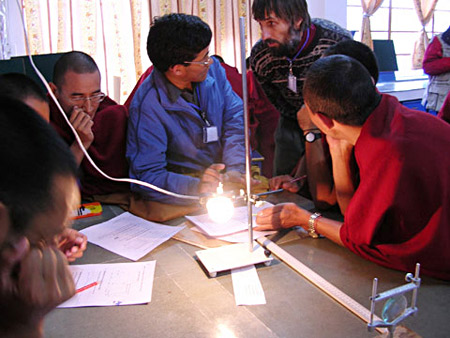
monks in the science workshop
In an educational complex located on the banks of a small river in a valley, In a place where Himalayas slopes descend towards Indian plains, a group of some 65 Tibetan monks and nuns are working with American scientists to unite their ancestral culture to the modern world.
"I would like to return to my monastery… Pass my knowledge to other monks, so that they can carry the process (scientific) To others” Tenzin Choegyal said, A monk of 29 years born in exile in India.
If that seems like a modest objective… It reflects an immense change in Tibetan culture, Where the change has been given to a glacial rhythm.
Isolated for centuries at the top of the high plateau of the Himalayas, and rejecting the entrance to almost all outsiders, The Tibet always saw little value in modernity.
Education was almost completely limited to monastic schools. Magic and mysticism were –And they are- part of the life of many people. New technologies were something that was feared: The lenses were prohibited well into the twentieth century.
No more. Pushed by the Dalai Lama, A tenacious defender of modern school, They were created in exile a series of programs to teach scientific education to the monks, The traditional core of Tibetan culture.
At the forefront is an intensive summer program, extended for five years, provided by professors from the Emory University of Atlanta. For six days a week, six hours per day, Teachers teach everything, From basic mathematics to advanced neuroscience.
"The Buddhist religion has a deep concept of the mind that dates back thousands of years", Larry Young said, A professor of Emory psychiatry and eminent neuroscientist. "Now they are learning something different about the mind: The mind-body interface, As the brain controls the body ". But ¿Why Tibetans are now hugging modernity?
Many of the roots can be tracked to 1959, When Chinese soldiers invaded Tibet in the midst of aborted uprising. The Dalai Lama and thousands of his followers fled through the Himalayas to India, creating a community in exile that now adds an estimate of 150 one thousand people around the world.
Beijing says that Tibet is an integral part of China. And while Dalai Lama insists that he only wants autonomy for his homeland, Beijing discredits him as an almost attempt at a distance from snatching China's control.
To the Tibetan culture, meanwhile, is increasingly. The ethnic Chinese have, stimulated by the generous government subsidies, Now they exceed Tibet's Tibetanos. The traditional Tibetan pastoral culture is disappearing with people moving to cities. Many Tibetan young people now speak a tango of Chinese and Tibetan.
The changing cultural panorama has broken in Tibet, unleashing violent uprisings every decade or less. In the most recent wave, About three dozen people have turned on fire during the past year in the Tibetan areas of China, protesting Beijing's policies.
In the midst of such a tumult, the Dalai Lama – A man raised to live in majestic isolation as an almost deity- It has passed, instead, Much of his life looking for ways for Tibetans to maintain their traditions, Even while they find their way in the modern world.
He has stimulated modern schooling for exiled children, and a democratic system to choose the Tibetan political leader (He resigned from his political powers in 2011). There are work programs for the large number of unemployed young people.
And for a few dozen monks and nuns, There is science.
The first Emory program group -26 monks and 2 nuns- He has already finished his five years of summer classes. Although they have not won titles, They are expected to help introduce a science curriculum in monastic academies, And they will carry with them textbooks in Tibetan language that the program has developed.
The Dalai Lama realizes that “the preservation of culture will occur through change” Carol Worthman said, An anthropology professor at the Emory Comparative Biology Laboratory. "You have to change to stay in place".
But change is something complicated. Particularly with a culture like this. The monks and nuns of the Emory program are "the best and the most brilliant", Worthman said, brought to the Sarah complex from monasteries and convents of all India and Nepal. While most are among their 20 and 30 years, Some are older and obtained their high degrees in Buddhist philosophy for a long time.
However, Few learned more than basic mathematics before the Emory program. For the way they study –focusing on debates and the memorization of long written passages, But doing relatively little writing- Few are able to take notes during classes in the classroom. Many were raised to see magic as an integral part of the world around them.
Observe them in class, however it is amazing.
None yawn. None sleep. Since none takes notes, It would be easy to think that they are not paying attention.
But then a monk or a nun in red habits, Raise a question about brain chemistry, or cell biology, the logic, who can stunned his teachers.
Although most only studied religious subjects after 8º grade, They regularly travel high complexity concepts: "They really understand how neurosurgery work at a level that is comparable to what we see in an advanced university student in the United States", said the neuroscientist Young.
For most monastic, however, The challenges are not of academic rigor. They do not see anything amazing in their ability to process a large amount of information without taking notes, or to remain attentive for hours until the end. This is how they have been trained.
For them, The challenges lie in intertwining modern science with its traditional beliefs.
The science program "was like a kind of cultural shock for me", Choegyal said, who lives in a monastery in southern India. While Tibetan Buddhism gives high value to skepticism, The conclusions are reached through philosophical analysis, Not through clinical research and pages and scientific data pages.
That's why it was difficult, at first, For many students. And the questions ranged between science and philosophy: ¿They are the batteries Senient beings? ¿How science knows that brain chemistry affects emotions? ¿They are tibetan beliefs in probable mysticism through science?
Sometimes, The program may seem incongruous, Given the widespread belief in magic. Such beliefs get well to the top: The Dalai Lama still consults the official oracle of the State, A monk who guess the future from the temple complex, not far from here.
But after five years, Choegyal says he has managed to maintain his basic beliefs while deeply delving into science.
"Buddhism basically talks about the truth, or reality, And science really supports this” said.
The questions that science cannot deal with belief in reincarnation, He leaves them aside as "very subtle themes".
Instead, He mostly finds echoes through the two cultures. He points to karma, The ancient Buddhist belief in a cycle of cause and effect, and how he plays in reincarnation. Then it points to similarities with the theory of evolution.
“Everything evolves, or change ", dice, already in evolution or reincarnation. "Then it is quite similar, except some kind of reasoning. ”-


