

Read original in English: My Take: Dalai Lama should condemn Tibetan self-immolations
* This article by Tenzin Dorjee was written in response to one written by journalist Stephen Prothero and published last 12 July. Prothero's article can be read by following the link: My Take: Dalai Lama should condemn Tibetan self-immolationsPor Tenzin Dorjee, special for CNN
Editor's Note: Tenzin Dorjee is executive director of Students for a Free Tibet, a global network of students and activists working for Tibetan independence. Writer and activist, He is a spokesperson for the global Tibetan youth movement
In a rude display of blind morality, Stephen Prothero's blog article on Tibetan self-immolations blames the victim rather than the harasser.
Tibetans are trapped in one of the world's last most brutal colonial occupations. It is through these lenses, more than anything else, that we should understand self-immolations.
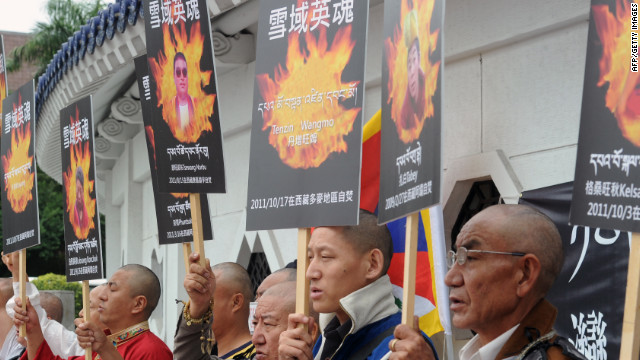
From 2009, at least 44 Tibetans –monks, nuns and laymen- They have set themselves on fire to protest against Chinese rule; 39 of these self-immolations have occurred this year alone. Each of these acts is a direct result of China's systematic assault on the Tibetan way of life., his movements, his way of speaking, your religion and your identity.
Instead of responding to Chinese oppression with vengeance –a much more tempting path for basic human instinct- Tibetans have chosen a much more peaceful environment. Without causing harm to a single Chinese, They set fire to their own bodies to shine a light on the atrocity taking place in their homeland.. They sacrifice their own lives, not in the name of “God”” that of “Buddha”, as Prothero disdainfully suggests, but with an altruistic intention to alert the world about the suffering of its people.
By demanding that the Dalai Lama condemn these individuals who have shown compassion beyond our imagination, Prothero has revealed a colossal indifference to the courage and circumstances of those fighting for the same democratic freedoms and human rights that he himself enjoys..
¿How can the Dalai Lama condemn self-immolations when his motivation was evidently non-selfish and his tactics non-violent?? ¿We would ask Gandi to condemn the activists in India's freedom struggle, who were killed while lying on the road to block British police trucks? ¿Or the hunger strikers who were dying to protest against the injustices of the British government in India?
In every sense, China's leaders, not the Dalai Lama, are responsible for self-immolations in Tibet. They have the power to calm tensions, revoke restrictions, and stop self-immolations overnight. But instead of seeking a lasting solution to the Tibetan question, They continue to aggravate the situation by intensifying repression.
No one is more tormented by self-immolations than the Dalai Lama, whose ties to the Tibetan people run deeper than language can express. In fact, It is the Dalai Lama's singular calming influence that has sustained the nonviolent movement to this day..
An act of faith, despair or protest: Self-immolations through time
As a universal icon of peace, The Dalai Lama's spiritual influence goes beyond the Buddhist world. However, Your moral authority is not an infinite resource.. There is an invisible moral rope with which the Dalai Lama has bound Tibetans to nonviolence for four decades. But this rope is growing thinner as China's tyrannical escalation pushes Tibetans into a corner..
self-immolation, which emerges as a tactic for having been cornered for too long, represents the last position on the spectrum of nonviolent resistance. If this last expression space, no matter how drastic, is removed, the rope could break. Chaos would be the result, greatly increasing the chances of a massive ethnic conflict, before which even the Dalai Lama would have exhausted his moral capital to stop him.
Of all Prothero's accusations, the most offensive is his comparison of self-immolations with sati, a social system in ancient India in which widows were pressured to throw themselves on the funeral pyre of their deceased husbands. self-immolation –an act of a political nature- It is the polar opposite of sati, a blind act of superstition.
There is not a single case of Tibetan self-immolation that was committed out of social pressure or religious obligation.. Every incident of these, unexpected as it is, moves the nation, the community, not to mention family, to its foundations. Every Tibetan prays in his heart that the last one was, indeed, latest.
The image of a person engulfed in flames is moving, often disturbing, for people who live in the free world. Despite all our obsession with violent movies and video games and live coverage of wars, It still breaks our hearts into pieces to see a human being on fire..
Instead of falling into philosophical investigations into the morality of self-immolations, we must see why these actions are: pleas for urgent help for a people pushed to the abyss by decades of ruthless repression.
One hopes that most people will focus on the real issue: ¿How will we respond to this call??
——————————————————-
Known as Phuntso
Liaison Officer for Latin America
NEW YORK TIBET OFFICE
Email: phuntso@igc.org


