

The New York Times | 2 June 2012
DHARAMSALA, India – A young Tibetan monk walked down street kicking Chinese military vehicles, Then he left a suicidal note condemning an official prohibition about a religious ceremony. Another frequent smile, I preferred to talk about Buddhism instead of politics. A third man, ex monje, liked to raise animals with nomads.
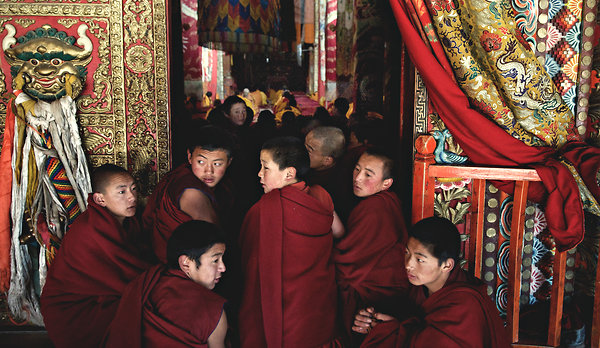
Everyone had used the crimson habits of the Kirti monastery, A venerable learning institution, surrounded by mountains on the eastern edge of the Tibetan plateau. All set fire in protest against the Chinese government. Two died.
At least 38 Tibetans have set fire from 2009, and 29 They have died, According to the International Campaign for the Tibet, A Washington headquarters with headquarters. The approximately 2000 Kirti monastery monks in Sichuan province, They have been at the center of the movement, one of the greatest auto-immolation waves in modern history. The acts evoke the auto-immolations of the early 60 South Vietnam's Buddhist monks, To protest against the corrupt government of Saigon.
Twenty-five of the auto-inmolves came from Ngaba, The county where Kirti is located; fifteen were young monks or former monks of Kirti, and two were nuns of the Mame Dechen Chokorling convent.
The Chinese paramilitary units are now bet in each block of the city of Ngaba, And Kirti is low blockade. Journalists are prevented from entering the monastery, What has made the question of how Kirti has become the volcanic heart of this eruption of self-immolations, something similar to a mystery.
But the monks and laity of Ngaba who have fled through the Himalayas to this Indian mountain city, They said that Kirti had radicalized in the last four years for an occupation of the monastery that meant one of the toughest repressions in Tibet. Chinese security measures have turned the white wall monastery with their temples and bedrooms and rows of prayer wheels, In a de facto prison, What has fed anger, that the measures are aimed at containing.
After five weeks of pause, Self-immolations resumed last week. He 27 of May, Two men in Lhasa, The Tibetan capital, Fire outside the Jokhang temple caught fire, The most sacred of Tibetan Buddhism. It was the first notable act of protest in Lhasa, in four years. One of the men was a former Kirti monk.
on Wednesday, A mother of three children, fire turned on fire and died in Ngaba, known as ABA, in Chinese.
Here Ngaba's exiles say that the security measures imposed on the city and the monastery have been extreme, Even for Chinese control standards in Tibet.
in 2008, During a tibet width uprising, Security forces opened fire on protesters in Ngaba with war ammunition, killing at least 10 civilians, Including a monk, according to the reports of defense groups and photographs of bodies that had been brought to Kirti. It was one of the most violent incidents of the uprising, and anger and alienation extended among local Tibetans. Officers strengthened security.
In February of 2009, In the city market area, A young man from Kirti self-unrusted, He was the first monk to do that in the modern story of Tibet. The monk, called Tapey, He survived, And the officers increased Kirti's surveillance. In March of 2011, The following auto-moving occurred: Phuntsog, of 20 years, Fire caught on the same street market, The ones that the locals now call the hero.
Local Tibetans say that the hard hand reaction of the authorities in the next six months after that incident, failure, encouraging the continuation of self-immolations. Chinese officers ordered the armed popular police to surround the monastery; They built a wall to cut a rear input; They prohibited all religious activities; They broke the photos of the Dalai Lama, The Tibetan spiritual leader; forced the monks to attend patriotic reeducation sessions; They cut Internet access; And they prohibited pilgrims from entering. They also took 300 Monks on a search night; Many of them have not returned.
Kanaya Trening, A Kirti monk in exile, who maintains contact with his colleagues in Ngaba, said around 300 Officers now live within the monastery to maintain surveillance. last summer, At the highest point of the patriotic reeducation campaign, Maybe there was twice that amount.
Another Kirti monk, Lobsang, He said that the paramilitary police had established four camps around the monastery.
"The most uncomfortable thing was to see the soldiers pointing their weapons towards you but not shooting you", Lobsang said, who recently arrived here and agreed to speak with the condition of just his first name was used. "This has been daily since 2008. For me, I would have preferred to shoot me instead of pointing their weapons towards me every day, 24 hours a day ".
He said that there is no coordination or organized plan for self-limo.
“I think those who were self-mooked did not have an official agreement, but there was a spiritual solidarity among people” said. "The energy of the Tibetan people is totally linked, Like a prayer accounts bracelet. You cannot find the end or the beginning because it is a circle ".
Chinese officers have condemned some of the self-weless as “terrorists” And they blamed Dalai Lama for inciting acts, A position he has denied.
Human Rights Watch researchers attribute a lot of frustration in Ngaba to the suffocating security and the "police technical provocative". The group found that the government's per capita expenses in Ngaba's security, in between 2002 and 2006 They were three times more than the average for the non -tibetan parts of the province of Sichuan. There was a rapid increase after 2006, and for 2009 It was five times more than for non -tibetan areas.
The senior officers have indicated their approval to the security operation. In February, The Chief of Ngaba's party, Shi Jun, He was promoted to the leader of the Sichuan Public Security Office.
A former monk with whom Lobsang had nearby ties, Rinne Dorje, He was one of those who felt suffocated by security. He left Kirti's monastery in 2010 To shepherd animals and make manual work, Fire caught in a primary school one night in February. Lobsang saw it for the last time in July.
“He told me he felt very uncomfortable and had headaches when he saw the atmosphere in Ngaba town,” Street said.
"He told me that he felt very uncomfortable and that he had headaches when he saw the atmosphere in the city of Ngaba.", Lobsang said.
That was also the case of Tapey, The first monk in self-moving, Lobsang said. Two days before your immolation in 2010, Tapey was walking between military trucks and kicking them.
“He was intentionally trying to provoke the soldiers” Lobsang said. “I asked myself‘¿What happens? ¿What's wrong with him?’ That day he was really different, And in his eyes I could see how he hated the military ”.
He 27 February 2009, A high Lama told an assembly of monks, that Kirti had to comply with official orders to cancel an important prayer ceremony, scheduled for that day. Tapey set on fire on the market, half an hour later, having left a note saying that he would commit suicide if the government prohibited the ceremony, Lobsang said.
"People respect their motivation and the price he paid for freedom", Lobsang said.
The next monk that was self-unrusted, Phuntsog, It never seemed to be in a bad mood, Lobsang said, who had studied with him. Phuntsog liked to joke and play with his friends, Often showing their biceps after flexing them.
“I never listened to any political agenda expressed by Phuntsog” Lobsang said. “The action he took is unimaginable to me. But, of course, We can now understand how many things he had to hide inside ".
After that self-impairment, The authorities began an intense reeducation campaign and blocked the monastery for half a year. That led to the radicalization of more monks. One of the most tense moments arrived in April 2011, When the officers sought to stop monks who were not from Ngaba. The city's residents tried to block the police and two major Tibetans were beaten until death, According to the International Campaign for the Tibet. The officers took 300 monks.
In August, A Court sentenced three monks to more than a decade in prison, Two of them for being involved in the self-limit of Phuntsog and one, a phuntsog guy, for refusing to return your body to the police at the time.
One day in September, after the officers had softened some restrictions on Kirti, Two monks ran to the market at noon, With your flame habits. One held the prohibited Tibetan flag of the snow lion. Before collapsing, one of the monks, If you come to Lobsang, A younger brother of Phuntsog, shout: "We are the defendants".
The incident was described by a witness who came to Dharamsala this spring. "Due to unfair judgments, repressive policies and discrimination, for all those things, The Tibetan people feel isolated” said. "Auto-immolations are not the end. This is just the beginning. ”-
Known as Phuntso
Tibet office in New York
Email: phuntso@igc.org


