

22 June 2018
By Carina Mongi
Thubten Wangchen is one of the best known Buddhist monks on the planet. He travels the world remembering the persecution against his culture and religion. And what he thinks about abortion.
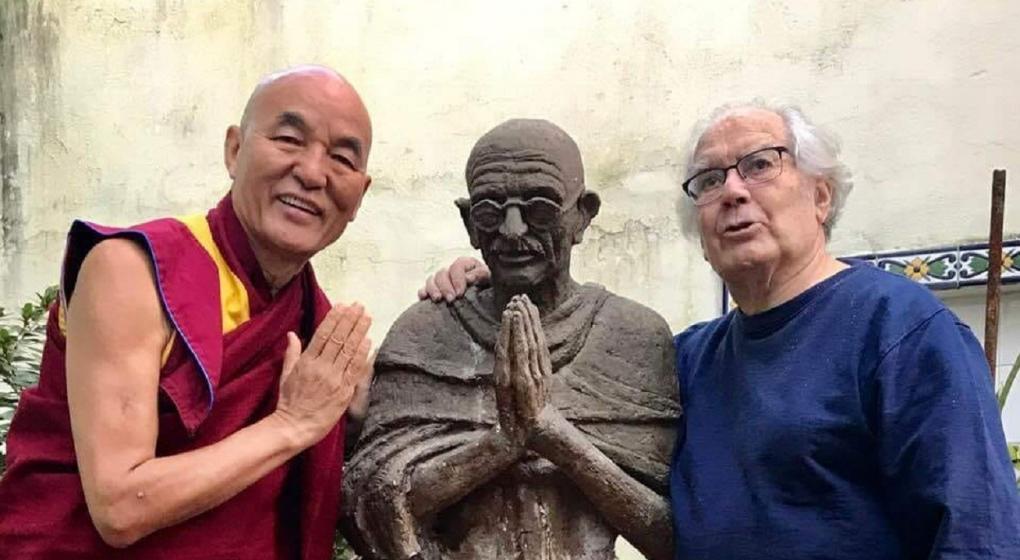 “Not even in the worst adversity should you lose inspiration or desire”, plantea Thubten Wangchen (64), one of the best known Buddhist monks in the world, on a cold night in the Calamuchita valley of Cordoba.
“I am Tibetan, “not Chinese”, clarifies firmly as soon as the dialogue with The Voice begins. It is not for less: suffered firsthand the fierce persecution undertaken by the Asian giant 60 years ago. His mother was murdered, among the million victims that the Tibetans estimate. Climbing on his dad's shoulders, crossed the Himalayas, with his brothers, to flee to Kathmandu in the middle of the invasion. Thubten says that he was a beggar child who lived for several years on the streets of Nepal and India.
Some, of the 150 attendees who heard it in the small mountain town of Villa Ciudad Parque, They probably Googled his name to find out who he was.. And they could find him hugging with the actor Richard Gere or with different world leaders. The founder of the House of Tibet in Barcelona travels the planet with his pacifist speech and talking about the Tibetan rights that –asserts– they continue to be beaten. The region does not demand independence but rather autonomy to be able to freely cultivate its cultural and religious traditions..
On his third trip to Argentina, Thubten arrived in this small town of three thousand inhabitants through the efforts of its communal chief., Hector Polcan, before the Indian Embassy. Sergio Lais Suárez was present at the talk, consul general of India.
The happiness
"The happiness, that everyone looks for even if they don't find it, “It has nothing to do with the outside.”, point. And he affirms that “it is cultivated and worked from within and allows you to project from within yourself so that the world is a little better”.
“People confuse, because the material, the money, technology and progress are not bad, They can help a little to achieve temporary happiness, But that one doesn't last long.", judgment.
“We never have to lose inspiration or desire.”, the past things have already passed, It doesn't help to keep thinking. “Buddhism teaches us to live in the present and act in the present.”, advise.
His talk, in correct Spanish, stands out for its simplicity. In Villa Ciudad Parque he covered his traditional attire with a regional poncho that the commune gave him..
From the street to school
At the request of the Dalai Lama, spiritual head of Buddhism, Hindu Prime Minister Nehru decided to help the thousands of Tibetan children who were begging on the streets, product of the exodus in the decade of 1960. “Those children were the future of Tibet”, points out.
To the 9 years, Thubten was recruited by the government. “They took me to schools where I could learn languages, philosophy, culture and tradition". To the 16, He decided to become a monk and entered the Dalai Lama's monastery..
Decades passed and Tibet still did not solve its problems. “Thousands of lamas or young people are in prison for having a photo of the Dalai Lama”, account. They are also concerned about the exploitation of uranium and gold and its effects on mountains and rivers that originate in Tibet.. As he maintains, by the economic power of China, no government or transnational institution, like the UN, supports the claim of Tibet.
Thubten believes that today is a time of learning and search in societies, both in Western culture (“who is looking for something beyond, in the East”) like in the east (“who also today want to learn something from the West”, brand).
Abortion, here
“It is a complicated topic to give an opinion on.”, Buddha did not speak anything about abortion, neither for nor against; does 2.500 years did not exist”, responds to one of the topics of debate in Argentina these days.
Personally –clarify–, only supports the method “if the mother is at risk”, and at most, until the third week of gestation. But, leans towards “giving the opportunity to be born to one more human in this world”.
Underline, at once, the need to “educate all young people and girls to use contraceptives or other means to avoid unwanted pregnancies”.


