

Our courts send the message that serious human rights violations should not be prosecuted. The legal reason is hidden to endorse the impunity of the great commercial allies
JAVIER DE LUCAS
JOSÉ ELIAS ESTEVE MOLTÓ
5 ABR 2019
Learn original and The country
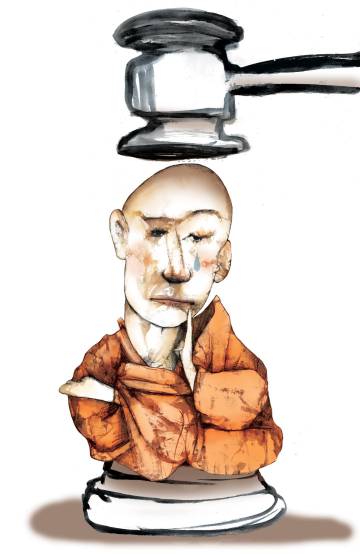
Illustration by EULOGIA MERLE
The fight against impunity for serious human rights violations has just experienced serious setbacks in Spain. On the one hand, the legislative project to recover universal jurisdiction through the reform of the article 23.4 of the Organic Law of the Judiciary (LOPJ), announced by the Minister of Justice, sank due to the firm opposition of the International Legal Advisory of the Ministry of Foreign Affairs, marked by the priority of relations with China. Let us remember that she was already buried in 2014 by the Rajoy Government, in the face of pressure from the Beijing regime, having issued international arrest warrants against leaders of the Chinese Communist Party for the commission of a crime of genocide in Tibet. This was stated publicly by the Foreign Minister at that time., Garcia Margallo, when he brought up the 20% of the Spanish public debt in the hands of China as the only reason that precipitated the legislative change. But, along with this frustration in the legislative order, a triple judicial debacle must be noted.
Indeed, more than four and a half years after the presentation by the socialist deputies of the unconstitutionality appeal against the Organic Law 1/2014 which de facto repealed the article 23 of the LOPJ, the plenary session of the Constitutional Court (TC) gave a resounding shelve in his Sentence of 20 December 2018. This bug, that granted constitutional validity to the legal reform of the PP, did not bode well for the interests of victims of international crimes. The ruling unambiguously admitted that “it can be concluded without difficulty that, as the appellants allege, the LO 1/2014 “restricts the scope of the previously regulated principle of universal jurisdiction”. But he dumped all the responsibility on the “legislator” himself., who is the one who has the power to establish the procedural requirements that he deems appropriate. And all this ignoring the pressure exerted by China, direct origin of the legislative change. Not to mention the suppression of popular action, or the absolute disregard for our international obligations arising from international treaties ratified by Spain, like the Geneva Conventions, that oblige signatory states to prosecute war crimes, or the Rome Statute of the International Criminal Court. The TC also ignores criticism from the UN of the reform, both by the Special Rapporteur for the promotion of truth, justice, repair and guarantees of non-repetition, the renowned internationalist and former president of the UN Human Rights Commission, Professor Fabián Salvioli, as by the Working Group on Forced Disappearances.
Special consideration deserves the participation in this sentence of those who, already as state attorney general, was particularly sensitive to the position of the US Embassy in the Couso case, and , later, as a judge of the Supreme Court, He was the speaker of the ruling that denied cassation to the Tibetan victims. We are referring to Mr. Conde Pumpido. In that verdict, with a reasoning that seems to us more typical of those who uphold the principle of realpolitik as a fatum of foreign policy and not of the criteria of a jurist and magistrate, He already warned that one cannot “ignore the problems in Spain's international relations that the expansive interpretation of Universal Jurisdiction was causing”. So, seemed to take the step from pragmatism to cynicism when he concluded that, if a victim cannot seek justice in the Spanish courts, must look for other alternatives beyond our borders: “The victim should activate jurisdiction in countries with better rights.”, well urge the State to act, in defense of his national, before the International Criminal Court”.
Only from cynicism can it be reasonable, For example, ask a victim of repression in Tibet or a Chinese Falun Gong practitioner to come to Beijing so that China, which is not part of the Rome Statute, report the case to an International Criminal Court that does not recognize. As cynicism is the other proposed option: look for the national court of another State, since here the doors are already closed to their cases and retroactively, even though they were investigated for more than a decade. Pragmatism and cynicism also seem to guide the TC's decision when it admits that “both possibilities are evidently burdensome for a victim.”, and place them in a situation of greater vulnerability.”, but, despite it, cannot be deduced “the absence of legal certainty, nor the introduction of an extravagant jurisdiction extension criterion, unpredictable or discriminatory. Pragmatism and cynicism is putting legal reasonableness in the background in order to guarantee the impunity of the great commercial allies., despite overwhelming evidence of the commission of the most serious international crimes.
This sentence wrote the first lines of the chronicle of an announced impunity. one month later, in a second failure, The TC came to ratify the file of the Falun Gong case, and just a few days ago, in a third verdict, The same has been done with the case of the Tibetan genocide, by dismissing the appeal for protection promoted by the Tibet Support Committee. In this last matter, despite including a case of torture committed against a Spanish victim, Thubten Wangchen, the lawyer's trick is resorted to that he did not hold this nationality at the time of the commission of the acts, to fail a decision that leaves you unprotected and totally helpless by our courts.
This triple judicial pronouncement fully repairs “the severe damage” that the spokesperson for the Chinese Foreign Ministry denounced, Hong her, In October of 2013, when the National Court decreed international arrest warrants against different leaders of the Chinese Communist Party.
With this tension definitively resolved, the great Chinese leaders can now rest in retirement., como Li Peng, former prime minister, accused of having committed genocide against the Tibetan people and directly responsible for ordering the entry of tanks into Tiananmen Square to massacre the student protest. And while, Their families hoard million-dollar accounts in tax havens.
All this happens when a few weeks ago the Tibetan victims were demonstrating around the world, remembering 60º anniversary of 10 March 1959, when the brutal Chinese repression of the demand for Tibetan rights forced the Dalai Lama and a good part of the rebels into exile. This spring commemorates, in addition, the 30thº anniversary of the student massacre ordered by Li Peng. The families of his victims will also demand justice. To each other, our courts send them messages of pragmatism and cynicism. ¿This is the international protection granted by countries that have ratified the Genocide or Torture Convention.? No: They are the effects of a foreign policy that is still rolling out the red carpet for the visit of the Chinese president, Xi Jinping. In case we hadn't realized, China is not Venezuela. But the politics of pragmatism and cynicism do not seem compatible with taking human rights seriously.. Only with its reduction to rhetorical ritual.
Javier de Lucas and Jose Elías Esteve are director and secretary of the Human Rights Institute of the University of Valencia (JEWS).


