

The Government limited 2009 the prosecution of international crimes
Fernando J. Pérez Madrid 21 NOV 2013
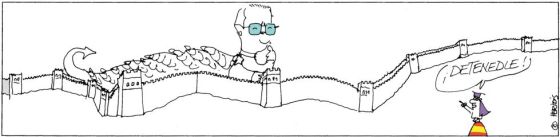
He principle of universal justice, by which a State declares itself competent to prosecute the perpetrators of crimes against humanity committed even outside its territory —as long as another country has not investigated them— has become an intermittent source of tension between Spain and other countries, some of them allies, like the United States or Israel. The actions of the judges of the National Court, generally following complaints from human rights defense groups, They have angered the affected countries and have often put the Spanish Government in a difficult position.. It is, from doors outside, has always uttered the well-known refrain of respect for the independence of the judiciary and the resolutions of the courts. Behind closed doors, however, The different Spanish Executives have tried to put a stop to the prosecution of international crimes, a diplomatic headache of the first magnitude.
The last conflict derives from the decision of the National Court to search for and capture former Chinese president Jiang Zemin and to investigate his successor, Hu Jintao, among other members of the political and military leadership of the Asian giant, for the Tibet genocide of the years 80 and 90 of the last century. This court case, in the hands of magistrate Ismael Moreno, started in 2006 after a complaint filed by the Tibet Support Committee (CAT).
From the beginning of the investigation, the Chinese authorities reacted with irritation. In June 2006, The Beijing Government called the Spanish ambassador to complain about the judicial proceedings on the Tibetan genocide, which they described as a "interference” in its internal affairs and a “total defamation”.
The opening of proceedings on the repression in Tibet coincided in time with the decision of the Supreme Court to force the National Court to investigate another complaint about the persecution of members of Falun Gong., considered a harmful sect by the Chinese authorities. The order to reopen that case against the spiritual group was taken with the criterion against the prosecution, who has also opposed the actions for the Tibetan genocide.
Frictions increased in October 2012 with the Emperor case, the investigation of the money laundering scheme headed by Gao Ping, Chinese businessman based in Madrid and currently in prison. Sources from the Court assure that there was “strong pressure” on the part of China to shelve this investigation and that the arguments to achieve this were possible economic retaliation.
More information
- The National Court orders the arrest of former Chinese president Jiang Zemin
- Beijing summons the Spanish ambassador to complain about accusations of genocide
- Garzón ordered prison for genocide and terrorism
- Moratinos promises to change the law to stop the judge, according to the Israeli minister
- ESPECIAL Emperor Case
universal jurisdiction, whose best-known exponent was perhaps the arrest in London of former Chilean dictator Augusto Pinochet In October of 1998 by order of the then judge Baltasar Garzón, has generated numerous proceedings in the National Court. They are currently still open, among other causes, the investigation into the genocide in Rwanda, that affects the president of that country, Paul Kagame; the prosecution of seven Chilean soldiers who tortured and murdered the Spanish diplomat Carmelo Soria, or of 20 Salvadoran soldiers who murdered the Jesuit Ignacio Ellacuría. Investigations also continue into clandestine CIA flights with terrorism suspects illegally captured and tortured in secret detention centers..
The profusion of genocide investigations —and diplomatic pressures— carried in October 2009 the socialist Government to agree with the PP on a legal reform to limit universal jurisdiction. Since then, Only cases that affect Spanish citizens are allowed to be investigated.. Curiously This cut was not advanced by the Minister of Justice. She was the then Foreign Minister of Israel, Tzipi Livni, who announced in January 2009 than its Spanish counterpart, Miguel Angel Moratinos, had informed him that Spain was going to change its legislation “to avoid abuses” of the judges of the National Court. Judges Baltasar Garzón, Fernando Andreu, Santiago Pedraz and Eloy Velasco protested this measure. “It's like closing social security to foreigners”, Andreu even stated.
Other pressures in this case of the United States, to stop Garzón's investigation into torture in Guantánamo or the death of Telecinco cameraman José Couso, They were known thanks to the leaks of secret cables from Wikileaks. These communications from the United States embassy in Madrid with the State Department revealed that the ambassador and his collaborators pressured ministers and officials of Foreign Affairs or Justice, and visited senior officials of the National Court in their offices, to try to ruin the judicial proceedings.


