

The PP reform threatened to block anti-drug operations in international waters
Jesus Duva Madrid 23 FEB 2014
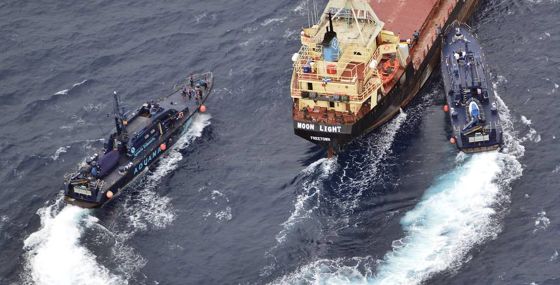
Intervention of a boat with drugs during a Surveillance Service operation
Customs. / Customs Surveillance
The Home Office has moved quickly to tweak an article of the reform of the law that limits the so-called universal justice, which is expected to be approved next Thursday in Congress. The initial wording prevented, or at least it made it very difficult, the possibility of police raiding ships loaded with drugs in international waters. Thanks to the new wording, Interior considers that the seizure of drug ships will continue to be feasible.
The past 17 January, The PP spokesperson presented a proposal in Congress to modify the organic law of the Judiciary of July 1985, concerning universal justice, until practically leaving it in nothing. The initiative only has the support of the party that supports the Government of Mariano Rajoy. No other group will support this express reform that seeks to end diplomatic conflicts derived from the prosecution of crimes outside Spanish territory, especially the one that recently emerged with China due to the investigation of the genocide in Tibet. The PP spokesperson, Alfonso Alonso, He has openly admitted that his interest is to eliminate universal justice because “it only provokes conflicts”.
The Ministry of Justice, directed by Alberto Ruiz-Gallardón, has agreed to process this legislative reform through a parliamentary route that allows the mandatory reports of the General Council of the Judiciary to be avoided, the Fiscal Council and the Council of State. The text of the PP is so restrictive that it limits the seizure of drugs on the high seas, the fight against clitoral excision suffered by mainly African women, and pedophilia. She further , will force dozens of judicial summaries to be filed, like the one related to the death of the Tele cameraman 5 José Couso, in 2003 an Iraq, by shooting by US soldiers.
Both opposition parties and groups of jurists believe that the legislative modification will open spaces of impunity that will make it difficult to investigate serious international organized crime crimes such as drug trafficking., and will leave unprotected women who are victims of genital mutilation or who suffer sexual exploitation..
Many of the groups affected by the legislative reform have openly criticized it, but they have been incapable of organizing and putting up a front to stop it.. However, he Intelligence Center against Organized Crime (GIRL), dependent on the Ministry of the Interior, He alerted his bosses that the PP project would prevent the capture of drug trafficking ships on the high seas. “It was worded in such a way that it left open the possibility that a cunning lawyer for a criminal network could derail a police operation.”, a CICO source explains to EL PAÍS.
The PP project established that the police, The Civil Guard or the Customs Surveillance Service could only assault and apprehend in international waters a boat with psychotropic drugs, toxic and narcotic drugs when “the procedure is directed against a Spaniard, when the crime had been committed on board a ship that had been boarded or inspected by the Spanish authorities with authorization from its flag State and is expressly authorized by a regional or bilateral agreement or arrangement, and when it involves the carrying out of acts of execution of one of these crimes or the constitution of a criminal group or organization with a view to its commission in Spanish territory.".
The confusing and abstruse wording of the rule came to assume that a ship could only be assaulted if all the premises contained in it were met.. Above all, If from now on “the express authorization of the country whose flag a ship flies would be required?”” or the existence of a bilateral agreement between Spain and that country. And it is that many of the more than 50 ships that have been assaulted in international waters by the police GEO in their 35 years of history have been without the express authorization of the countries whose national flags the ships displayed.
An illegal business that affects Europe
The Intelligence Center against Organized Crime (GIRL) considers that the boarding of narcoships is part of the “international commitments” from Spain and is supported by the article 17 of the UN Convention against Illicit Trafficking in Narcotic Drugs. This convention empowers States to raid ships, although imposing on them the obligation to “promptly inform the flag State of the results of that measure”. The CICO has a service 24 hours a day to fulfill that obligation.
Senior police officers highlight, besides, that Spain is part of the MAOC-N (Maritime Analysis and Operations Center against Drug Trafficking) together with France, Ireland, Italia, Netherlands, Portugal and the United Kingdom. It is an organization created in 2007 to combat the entry of drugs by sea into Europe. The seven countries carry out joint raids (Planes from the Italian Guardia di Finanza participated in one of the last operations of the Spanish police). Since its creation, MAOC-N forces have seized 80 tons of cocaine and more 60 cannabis tones.
police experts, The Civil Guard and the Customs Surveillance Service agree that behind most of the vessels seized in international waters there are Spaniards or multinational networks that intend to settle in Spain to distribute drugs throughout Europe.. This fact, according to these sources, justifies that there continues to be “universal justice against drug trafficking”.
Most drug trafficking ships use flags of convenience or are simply pirates with false flags or from small countries with which there is no bilateral agreement.. “What the police usually do is communicate with the country whose flag they fly and request permission to assault it.”. If the country in question does not respond in 24 hours, we take the boat. There is reiterated jurisprudence of the Spanish Supreme Court that supports this procedure even while recognizing that it is an irregular procedure.", assures a CICO source.
The Ministry of the Interior and Justice have retouched the legal article prepared by the PP, so that the concurrence of all the conditions imposed by the initial draft is not required, but it is only mandatory that you have one of them to be able to board a ship. Enough like this, For example, with the ship having been “inspected” by the Spanish authorities.
Interior sources believe that the new wording of the article referring to the capture of drug ships will pass in Congress without difficulties. They also consider that it is in accordance with what the Popular Group establishes in the explanatory statement of the legislative reform.: “That the extension of national jurisdiction outside its own borders, entering the sovereignty of another State, must be limited to the areas that, provided for by international law, "must be assumed by Spain in compliance with the international commitments acquired.".


