

PHOTO: Bronze bowls used in religious ceremonies in the Lablang monaserio (China). / Z. Aldama
The permits turn the trip to the ‘world roof’ In a bureaucratic nightmare, But there are places in China, como Xiahe, that allow to approach this fascinating culture
Criminal Aldama 13 SEP 2013
A 3.000 meters high, The air is cold and clean, But the oxygen is scarce. The lungs protest, The muscles are numb and time seems to slow down: One step, A step, A sigh, And a break. The inhabitants of perpetually sound cheeks, however, They seem to move in a fast camera, outside the complications that carry the movements of visitors in Xiahe. Lablang's Buddhist monastery, Belonging to the Tibetan Order of Gelugpa and the most important outside Lhasa, bustling with activity.
More than a thousand monks dressed in blood-colored robes come and go, they go up and down, dodging the cameras of travelers with a frown and a well-raised index finger pointing menacingly at the target. As a contrast, indifferent to the constant disembarkation of buses full of Chinese tourists, Tibetan pilgrims arrive at the religious complex after having traveled hundreds of kilometers to circumambulate the thick reddish-walled buildings and spin the ornate prayer windmills. some walk, others advance on their knees. Everyone feels like they are at home.
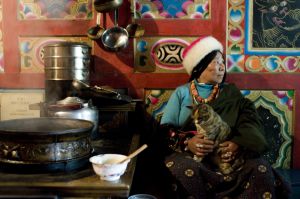 PHOTO: An ethnic Tibetan woman cooking for her foreign guests in Jiuzhaigou (China). / Criminal Aldama
Not surprisingly, More than 50% of Xiahe's population belongs to the Tibetan ethnic group, A percentage that exceeds even Lhasa. And the people, stuck in an impressive valley protected by steep mountains whose highest point is to 4.636 meters above sea level, It could perfectly be located on the roof of the world. But although historically it is part of him, Technically Xiahe does not belong to Tibet.
Like other areas of Tibetan influence that overflow the borders delineated by the Communist Party, The small town is administered by the Chinese province of Gansu. That is why it is not necessary to obtain the cumbersome permits —Very difficult to get after the 2008 revolts— that open the doors of the Tibet Autonomous Region, established in 1965. “They told me that it was almost impossible to get papers to travel independently to Lhasa, So I preferred to come to what they call 'the other Tibet', comments an Australian backpacker.
Xiahe can be reached without problem from Lanzhou, the capital of Gansu, after four hours on the bus. And the beauty of the landscape is well worth having your nose pressed to the window.: The dry ocher that invades a large part of the province is losing the battle it fights against the green as the vehicle climbs the mountains.. The aridity of the desert disappears to give way to a world of impressive waterfalls and plains dotted with temples and traditional Tibetan houses..
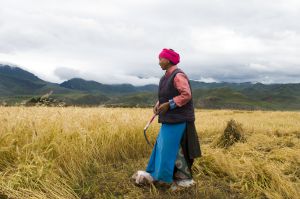
PHOTO: A field around Xiahe (China). / punishment ladder
Not far from there, in neighboring Sichuan Province, the Tibetan atmosphere intensifies. Towns like Songpan, Sershu o Ganzi, easy to visit in a single trip of between one and two weeks, They are the best way to immerse yourself in this ancient civilization with a simple tourist visa. And by the way, the traveler can marvel at the disconcerting spectacularity of the colorful lakes of Jiuzhaigou, a natural park 720 square kilometers.
Nevertheless, this area, which includes Aba prefecture, It is also one of the most conflictive. Here, and not in official Tibet, It is where a large part of the immolations that since 2009 have carried out, to protest against the Chinese occupation, more of 110 Tibetans. And perhaps because the Chinese Government is aware that it has to learn to respect cultural diversity and generate economic opportunities for the Tibetan minority., around Jiuzhaigou, and within a pioneering ecotourism program, The possibility of living with a family of this ethnic group is offered.


