

The popular present a proposition of law that cuts the universal jurisdiction
The party wants to avoid a diplomatic conflict over judicial investigations
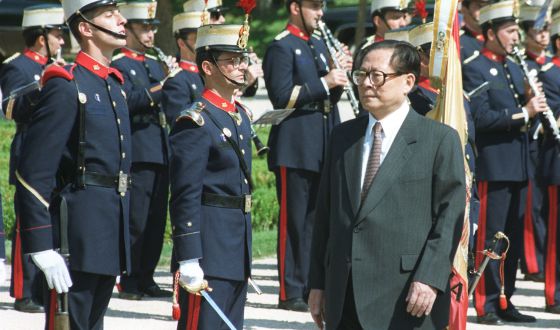 Official Reception to the then Chinese President, Jiang Zemin, during his visit to Spain in
1996. / J. M. PASTOR(EFE)
The Chinese giant or gets counted. The Spanish government wants to avoid a diplomatic conflict with Beijing at all costs and is not willing to investigate the judges cloud economic relations with which it is already the first commercial power in the world. Thus, has launched an express and cover legal reform whose objective is to file as soon as possible The open cause at the National Court for Tibetan Genocide, in which the arrest of five members of the communist nomenclature has been ordered, including former president Jiang Zemin and the former Minister Li Peg.
To give the maximum speed to this reform, that drastically cuts the scope of the so -called universal jurisdiction, A singular procedure has been used: The presentation of a proposal of the Popular Group law in Congress. Initially, The Government planned to include this modification in the reform of the Organic Law of the Judiciary prepared by the Ministry of Justice, But this would force reports from the General Council of the Judiciary (CGPJ), The State Council or the Fiscal Council, So the process would lengthen months. Using the PP, The Government prevents the reform from passing through the Council of Ministers, The phase of the reports is skipped and, If it imposes the emergency procedure, It can be in force in two months. Groups that support the government do not usually present law propositions, because it is supposed to be to whom the legislative initiative corresponds. In fact, The PP had not presented any in this legislature. That is why it is more surprising.
Requirements to investigate
Genocide. That the alleged responsible is a Spanish or a foreigner who resides or is in Spain and his extradition has been denied.
Terrorism. May the alleged perpetrator be a Spaniard or a foreigner who resides in Spain or has been committed by a legal person domiciled in Spain or there are victims of Spanish nationality or the crime has been committed to condition a Spanish authority or the objective has been an EU institution with headquarters in Spain or an ship or aircraft with Spanish pavilion or an official Spanish installation (Embassy or consulates).
Torture. That the alleged person is a Spanish or the victim was Spanish at the time of the events and the person to whom the crime is imputed in Spain.
Piracy. That the alleged person is a Spanish or the victim is a Spanish or a ship with a Spanish pavilion.
Crimes against sexual freedom of minors and violence against women. That the alleged responsible is a Spanish or a foreigner who resides in Spain or that the victim is Spanish or resident in Spain provided that the accused is also in Spain.
Treat human beings. That the alleged responsible is a Spanish or a foreigner or legal entity resident in Spain or the victim is Spanish.
Corruption. That the alleged responsible is a Spanish or foreign resident in Spain or member of a society or legal person domiciled in Spain.
Forced disappearance. That the alleged person is a Spanish or the victim was Spanish at the time of facts as long as the accused is in Spain.
in 2009, Socialists and popular agreed a first cut of universal jurisdiction To avoid diplomatic friction. Also then they did it through the back door, presenting an amendment to the Law on the Creation of the Judicial Office, Congress processed. Now the PP, With an absolute majority, He has not even sought the complicity of the PSOE.
The reform of 2009, still in force, He left an open door to the National Court to investigate crimes abroad when his alleged perpetrators were in Spain, there would be Spanish victims or there was "some relevant connection link with Spain". It is that door that you want to close, eliminating any ambiguity.
The proposition that the PP presented in the Congress Registry last Monday indicates that Spanish judges will only be able to investigate crimes of genocide and be humanity, as in the case of Tibet, when "the procedure is directed against a Spanish or a foreign citizen who usually resides in Spain or was in Spain and whose extradition would have been denied by the Spanish authorities". As those accused in the case instructed by Judge Ismael Moreno are Chinese citizens and none is in Spain, that is known, It would not be possible to investigate. She further , The reform makes it clear that the crimes of the so -called universal jurisdiction will only be "prosecutable in Spain prior interposition of complaint by the aggrieved or by the prosecutor". Popular action is excluded, provided for in the article 125 of the Constitution.
The prosecutor never filed a complaint for the Tibetan genocide, but they did the popular action (exercised by two solidarity foundations with the Tibet) and the particular accusation (The Spanish nationalized tibetan Thubten Wangehen). With the reform, The first could not report.
It would still be a last loophole to keep the investigation alive: that the qualification of the crime was changed from genocide to torture, since in the latter case the victim's nationality is taken into account. But the reform demands that "the victim had Spanish nationality at the time of commission of the events"; A requirement that does not meet the aforementioned Thubten Wangchen.
Although criminal laws favorable to prisoner are retroactive, So the reform should mean the complaint file against the dome of the Chinese Communist Party, The PP has wanted to clear any questions that the judges may raise and has included in its text an unusual transitory disposition in which it is ordered taxatively: “The causes that at the time of entry into force of this law are in process […] will be dismissed until compliance with the requirements established in it is accredited ”. That is to say, First investigations are archived and then examined if they should be reopened, against all logic. Just like now, The reform imposes the obligation to file a case when the crime is being investigated in the country in which it occurred but leaves, As a novelty, To the Supreme Criminal Chamber the ability to decide if a State has a will, or capacity, To judge it. One of the most surprising aspects of the reform is the unequal treatment given to the different crimes. It will be enough, For example, with which there is a Spanish victim to investigate a crime of terrorism or piracy committed abroad, But the victim's nationality will be irrelevant to a crime of genocide. On the contrary, In cases of torture and forced disappearance, it will be required to investigate that the victim was Spanish at the time of the events and, besides, That the accused is in Spain. A discrimination that can put in solfa the right to judicial protection.


