

BY MARÍA PILAR PARENTE AND ROBERTO CARLOS MIRAS
Thursday 18 July 2019
At the time, The designation of Beijing as the venue for the Olympic Games made the Snow Country topical. Guy Sorman political analyst of recognized prestige and author, among others, of “The genius of India” (Editorial kairos) published an essay in which he explained his way of seeing China and its people for a year, “The year of the Rooster. Chinese and rebels” (Drop by Drop Editorial). But, currently more than 130.000 Tibetan refugees live mainly in India and in countless communities in Nepal, Swiss, United Kingdom and the United States and in others 30 more countries among which is Spain.
The Tibetan population in the year 2008 it barely reached six million inhabitants, distributed by a territory of 2.200.000 square kilometers and 28 Tibetans immolated themselves due to the repression they are suffering from China. Many monks and nuns have protested by burning themselves in different Chinese provinces.. And to some 1370 meters high we are in the city of Dharamsala, “little Lhasa” in northern India. Place where the current Dalai Lama resides. More of 3000 Tibetans have made this small corner their place of residence. Travelers come from all over the world to have an audience with the “God King.””
Many of these Tibetans live in the urban center of Mc Leod Ganj, which has become a bustling commercial center.. Near Namgyal Monastery and hosted by Jetsun Pema, hermana del Dalai Lama, we find one of the three convents where they are located 160 tibetan nuns, many of whom arrived after suffering many hardships. In the year 1973, Under the supervision of the Department of Culture and Religion of the Tibetan Government in exile, the Geden Choeling Buddhist Education Society was created.. And more than 5000 children and currently have formed more than thirty homes, two residences and schools where inmates live around 1200 children who study three languages: Tibetan, Hindi and English. The city is abuzz. “And it was as a result of a dispute, when Tibet practically broke diplomatic relations with China between 1915 and 1945. It had a Government and maintained relations with several foreign countries – explains Matthieu Ricard, buddhist monk, Dalai Lama translator, and son of the late Jean Francois Revel-, in 1949 They militarily invaded Tibet starting from the east, the Kham region. The invasion was brutal. And over time it became clear that they were going to conquer Tibet.". Already before the Cultural Revolution, six thousand monasteries were destroyed, almost all. Libraries were burned, the broken statues and the shattered frescoes. Perhaps this was the reason why the writer Javier Moro, with several books of denunciation to his credit, published, “The Buddha Mountains”, (Seix-Barral) where through two of its protagonists it told a true story. “Together with a group of people we formed a group for the defense and freedom of the Tibetan people. The situation is very bad. The Dalai Lama met with us in his room telling us that we had to denounce, because things are happening that are not told. We have created a page www.tibetcat.com where we report on the fight for a free and independent Tibet. In this book that is on the street, I tell the true situation of two young women who join a group of refugees to cross, at night the highest peaks in the world” The Tibetan government in exile does not stop repeating that a cultural genocide is taking place in Tibet. ¿It's true?, ¿the study of the Tibetan language is prohibited?, ¿there is religious freedom?, ¿and political freedom? These are some of the questions it answers, Iñaki Preciado Idoeta, translator and Doctor in Philosophy from the Autonomous University of Madrid, as well as a great connoisseur of the Tibetan people, well since 1996 has made Tibet his place of residence. And between his jobs, we can quote: “In the Country of Snows” (Martinez Roca) or the first version of the “Life of Milarepa” published by Anagrama and now republished by Miraguano “In what respects freedoms, politics should not be confused with religion. It is true that in Tibet there is no political freedom to demand independence. Tibetans are not recognized as having the right to decide their destiny as a people.. Now when we talk about religious freedom: The proportion of monks and nuns that exist in the entire Tibetan territory transferred to today's Spanish population would be equivalent to one million religious. In the Serta district (Sochuan) there is a monastic university where they live 8000 monks and nuns; and in other places there are monasteries with 2000 and 3000. English is taught in evening classes, often by North American missionaries” José Elias Esteve Moltó, Doctor of Law, after a long period of study- has done the best work internationally on this topic: “Tibet. The Frustration of a State” where he analyzes the situation of a town. and asks many questions: “Why Tibet in the year of occupation in 1949 It was a State according to International Law and, as a consequence of this, the entire Chinese occupation is illegal? O ¿What has been the action of the Chinese Government from the middle of the last century to the present on the Tibetan people??” José Elías Moltó-, leaves us a reflection: “They did not want to denounce their own facts, his own tortures before the judge. When they entered prison the first thing they did was torture them and they did not want to report- here in Spain, at the National Court, because they thought that they were going to do the same thing to their tortured people that they did to them…”
TENZIN GYATSO, HIS HOLINESS THE DALAI LAMA
Tenzin Gyatso, His Holiness, the 14thº Dalai Lama, He is the spiritual and temporal leader of six million Tibetans. He was born 6 July 1935 within a peasant family from the small town of Takster, in northwestern Tibet. With two years –was recognized-, according to the tradition of his country as the reincarnation of the previous Dalai and therefore the reincarnation of Avalokiteshavara, the Buddha of compassion. in 1950 when Tibet was threatened by China, the head of state fell to him. Beijing's policy in Western Tibet gave rise to popular uprisings in favor of independence. in 1959 His Holiness went to India where, from 1960 presided over the government in exile. in 1963, as a model for a free Tibet, promulgated a democratic constitution based on Buddhism and the Universal Declaration of Human Rights. He has received various distinctions and several international awards., including the Nobel Peace Prize in 1989.
BIRTH OF TIBETAN BUDDHISM
Buddhism came to Tibet towards the year 650. A native religion known as bon was practiced in two forms: a priestly era at the service of the first kings, sacred rulers. The other was a religion of the shamans of rural communities. These were religious adepts whose abilities consisted of controlling local deities and spirits.. Most shamans of northwest Asia reinforced their rites with dances, songs, drums and amulets. With the arrival of Buddhism certain aspects of bon were absorbed.
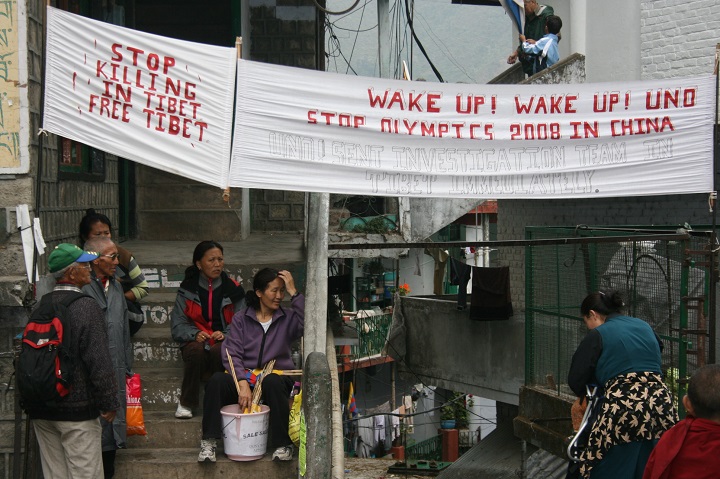
Mc Leod Ganj (Photo: Roberto Carlos Miras)


