

AUTHOR: A. GARCÍA. HONG KONG / SEVILLA
JUICIO A LOS LÍDERES DEL MOVIMIENTO 'OCCUPY CENTRAL'
As authorities prosecute pro-democracy activists, The former British colony plummets in the freedom of expression rankings.
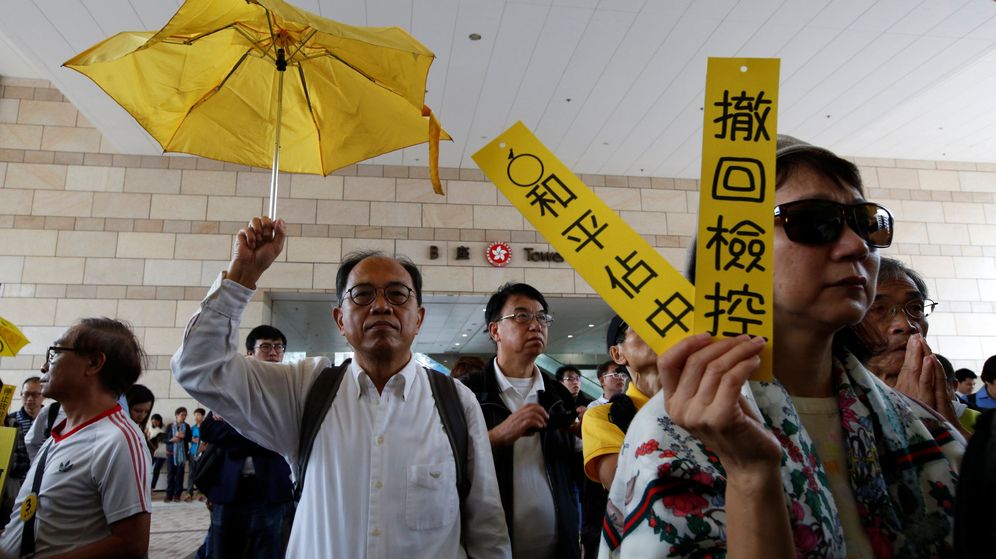
Supporters of the pro-democracy movement Occupy Central demonstrate in front of the
court that judges its leaders, a hong kong, he 19 November 2018. (Reuters)
Hong Kong shows signs today that he suffers from a serious and contagious illness: What happens there has its replica in many parts of the world where Rights are cut due to ascending Chinese influence. The symptoms multiply: proof of this is that, For example, the past 26 October Judge Andrew Chan, of the Supreme Court of Hong Kong, considered legally justified the sentence of four months in prison for a homeless elderly man who joined pro-democracy protests del llamado '15-M hongkonés', he Umbrella Movement of 2014. Although the magistrate recognizes that the homeless man was not involved in any illegal or violent activity, believes that waving a yellow banner in favor of universal suffrage and displaying a defiant attitude towards the police constitute punishable behavior. The majority of experts warn with concern that the formula “One country, two systems” that has governed the former British colony since its reintegration into China in 1997 has stopped working.
This Monday nine citizens sat in the dock whose only crime was peacefully protest against injustice and lack of democracy in one of the most economically developed metropolises in the world. Among those prosecuted is the Occupy trio, made up of two university professors –Benny Tai, jurist, and Kinman Chan, sociologist-, along with a survivor of the Tiananmen massacre –Reverend Chu Yiu-ming-, with whom we have had the opportunity to talk on several occasions.
The three activists are accused of conspiracy and incitement against public order during the umbrella demonstrations. 2014, in addition to “incitement to incitement”” (something quite unusual, Well, according to the Italian professor S. Casabona, this crime is usually applied more to cases of terrorism). Doubts about the legitimacy of the position have become even more accentuated since the 6 April 2017 The Supreme Court of Australia has declared it unconstitutional under the Common Law, which also applies to Hong Kong. Yet, the prosecution maintains its position and requests until 7 years in prison for the accused. one of them, Kinman Chan, has stated about it: “More than a million people participated in the occupations.”. Consider that they did it at the instigation or manipulation of us It is a lack of respect for the will of the citizens. (…) But only in the darkest hours can you see the stars.".
Given the alarming erosion of the system of fundamental guarantees that the trial is revealing, Amnesty International has launched a campaign for activists which surprisingly precedes his conviction. The reason for this haste is that stifling the expression of civil society and the democratic movement. “Public opinion must be awakened because the world is not paying enough attention to what is happening in Hong Kong.”, "People don't get the idea of what the lack of freedom of expression means in this context.", declared William Nee, Amnesty researcher.
In parallel, international indicators leave no room for doubt. According to Reporters Without Borders, from 2012 –the year of the coming to power of Xi Jinping– Hong Kong has fallen from position 54º al 73º in the world ranking of freedom of expression. These figures are even more eloquent when compared with data from 2002, when the metropolis occupied 18º place. Hence the forcefulness with which the Hong Kong Journalists Association has positioned itself in its latest report, when qualifying la propaganda nacional en torno al llamado 'Sueño Chino' truly “nightmare””.

The Occupy Trio collecting donations for the Justice Defense Fund, what is
dedicated to helping activists and politicians who are being prosecuted, he 1 July
of 2018. (A. García)
Facing decline, nationalism and repression
The current situation harbors a hidden but deep crisis in the Chinese Communist Party (PCC) and in the regime that he leads as a de facto single party. Since the time of Deng Xiaoping's reforms in the 80, and especially since 2001, date of entry into the World Trade Organization (OMC), China has experienced unprecedented progress in human history. The potential of current technology, combinadas con lo que la revista The Economist denomina 'crony capitalism' –“buddy capitalism”-, has allowed the powers and resources of the State to be put at the service of a business elite in close collusion with the political elite, thus achieving a synergy that has translated into extraordinary levels of growth for four decades.
Due to the opacity of the system, one-party authoritarianism, the lack of judicial independence and the absence of freedoms no system of checks and balances has been established ('check-and-balance') to evaluate the aforementioned operations in a democratic manner and in accordance with the law. This has generated a progressive disaffection among citizens with respect to the supposed ideals and values promoted by “socialism with Chinese characteristics.”” and a focus on mere material benefits. “Currently the only guarantee of survival of the regime is to maintain the pace of wealth creation “which has allowed us to cushion other types of demands from civil society”, explained Benedict Rogers, founder of Hong Kong Watch.
Aware of the country's ideological decline, President Xi Jinping has proposed revitalize nationalism and strengthen the system of controlsabout the press, academia and public opinion. “Civil society lives today in China the harshest repression since Tiananmen”, Rogers denounced during his last visit to Spain. This tightening has materialized in the regulatory field with a series of laws and prohibitions like those stipulated in April 2013 regarding seven politically sensitive areas –including freedom of the press, the establishment in October 2014 of a Social Credit System that discriminates against “disobedient” citizens” to the regime, the promulgation of a new National Security law in July 2015 which has meant the arrest of dozens of human rights lawyers and, two years later, the approval of a Cybersecurity law that legitimizes official espionage and tight control of communications.
Regarding the Hong Kong Special Administrative Region, Beijing has progressively modified its roadmap, breaching its commitment to guaranteeing truly democratic elections for 2017. Regarding the equation “A country, two systems, has decided to prioritize the first factor, to the detriment of the second.
This turn has had one of its crucial moments in 2012, date on which the Hong Kong Executive –at the request of the central government- tried to impose an educational curriculum that included ideological indoctrination in favor of the communist regime. Faced with such a display of authoritarianism, the activist Joshua Wong with barely 14 years old mobilized citizens and managed to nullify the initiative. The following year, in 2013, Scholars Benny Tai, Kinman Chan and Reverend Chu Yiu-ming, began a campaign of civic deliberation inspired by political scientists Habermas and Fishkin: “We wanted to integrate all strata of society so that they could reflect, debate and make political proposals based on your needs and interests. We group them by professional sectors without forgetting the 'homeless', "Well, their situation has to do with the way the city is governed.", Chan has clarified.

MP Tanya Chan, of the Civic Party, one of those processed these days, in an act
together with the pro-democracy group Boyz Reborn, one of whose songs became an anthem
during the Umbrella Revolution, he 1 July 2018. (A. García)
An absolutely unequal society
The absence of democracy in Hong Kong effectively entails a significant inequality in the distribution of wealth. The Gini index, which measures economic inequality, has reached 0,539 points: This is the highest figure in Asia and in all developed countries. Even pro-regime institutions like the SCMP newspaper, from the Alibabá group, have warned that the 10% richest citizen wins 44 times more than 10% in the lowest income bracket. “Many people live in micro-housing, some are called 'coffin apartments'’ because they are reduced to the space of a mere bed with bars around it.”, says young activist Alex Chow.
In a scenario burdened by such deficiencies, Two significant events triggered the citizen mobilizations of 2014. In June of that year, The Chinese State Council published the White Paper on “A country, two systems”, emphasizing reunification with the continent as the ultimate objective. In August, The National People's Congress stipulated serious limitations on the presentation of candidates for the elections to the Head of the Executive. Both news caused chain reactions. First of all, a massive student strike called by Joshua Wong and Alex Chow, from the organizations Scholarism and HK Federation of Students. In second place, the occupation of Central –the city's financial district, where the students were joined by many other citizens led by Benny Tai, Kinman Chan y Chu Yiu-ming, who proposed civil disobedience and peaceful resistance under the motto Occupy Central with Love and Peace (OCLP).
This is how the Umbrella Movement was forged., named thus by the press before the massive use of umbrellas against tear gas which was repeatedly used by police to disperse protesters during the 79 days that the mobilizations were extended. They ended when their leaders surrendered to the authorities in the absence of progress in the negotiation.Such antecedents explain why the trial that begins on 19 November is so important to Hong Kong society, for the rest of China and for the entire international community. “Hong Kong has been the mirror where the continent has looked at itself as it carries out its economic transformation and its unstoppable rise.”; What happens there on the political level could bring far-reaching consequences for the regime”, says the head of a financial consulting firm related to the government, who prefers to hide his identity.
In that context, just after finishing the first session of the trial, The Occupy trio wanted to highlight the following: “The purpose of our acts of civil disobedience It is not challenging the rule of law; on the contrary. Fighting in this way for universal suffrage guarantees that the law is made by the people and is based on a public mandate., which consolidates the justice and authority of the Law. […] If the charges are confirmed, there will be a serious intimidating impact on the Hong Kong public and the government will be able to purge the entire Democratic side on the basis of this precedent.".
If true democracy triumphs in the former British colony –not an adulterated substitute-, the world will have some guarantees that China can behave as a reliable business partner and as a responsible global power. But if it fails, international public opinion will recognize that Beijing not only suffocates the legitimate demands of its civil society, but also fails to comply with its national and international commitments.


