

For decades, 150.000 Tibetans who fled China take refuge in India. ABC visits its Buddhist monasteries and shelter centers in Darjeeling

Pablo m. TEN – PabloDiez_ABC Special Envoy to Darjeeling (India)
18/09/2016
They escaped from Tibet decades ago, leaving their families behind, and they know that they will die without returning to their land. Fleeing the authoritarian Chinese regime,200.000 refugees form the Tibetan diaspora, of which 150.000 have settled in India under the shelter of their revered spiritual leader, the Dalai Lama, exiled in this country.
After his escape through the Himalayas when a popular revolt against the Chinese Army failed in 1959, Thousands of Tibetans followed in the footsteps of the «Ocean of Wisdom» in search of freedom. Thupten Gyaltsen y Palden Phintsok, two monks who were hanging around the 30 years when they escaped together in 1961, today they are close to the 90 and they spend their last days in the monastery of Guru Sakya, outside Darjeeling. In this hill station in the shadow of the Himalayas, Built during the British colonial era and famous for its delicious tea, several thousand Tibetan exiles live. Added to them are those who live in Dharamsala, where the Dalai Lama resides, and those distributed infifty settlements in southern India.
«I've spent my whole life here and this is my home, but it is very sad to be far from your loved ones», Monk Palden laments to ABC, who left Tibet, abandoning the five members of his family, «to flee the Chinese occupation». Although they have passed 55 years, remember your escape as if it were yesterday. «It was very dangerous; It took us two weeks to reach Nepal because we had to cross the mountains on foot, enduring the cold and traveling only at night so that the Chinese soldiers would not see us., who shot at those who tried to flee», the monk recalls with sadness.
Until several decades later, when Deng Xiaoping started in the years 80 the opening of China after the death of Mao Zedong, Palden Phintsok did not know anything about his relatives. In the 90, thanks to a agreement of the Chinese and Indian governments, He was authorized to travel to Tibet along with ten other exiles to visit his family.. «Although my parents had already died, It was one of the happiest moments of my life because I was able to meet my brothers again», says the monk sitting on the terrace of the monastery, where he contemplates with melancholy the mist that envelops the cliffs of Darjeeling. Below, between the fog, resounds the «toy train» steaminaugurated by the British in 1881, which is still operational for tourists because it is a World Cultural Heritage.
Lost in the landscape with the elderly Thupten Gyaltsen and Palden Phintsok, the monk Gendun Dhargye, of 50 years, agrees with them by pointing out that «I miss my family a lot», but make it clear that «I can't go back to Tibet the way things are because there is no freedom.». After fleeing in 1992 to get rid of classes «patriotic reeducation» imposed by the Beijing regime, his father, a farmer from Shigatse, he spent in jail 1996 a 2006 for demonstrating against China.
Like its other border areas, Tibet was part of China when its imperial dynasties were strong enough to control it., but it has never been an independent state recognized by other countries. During the Yuan dynasty (1206-1368), Kublai Khan, grandson of the Mongol leader Genghis Khan, He incorporated Tibet into his dominions. The fall in 1911 of the last emperor of China, Pu Yi, and the chaos during the First Republic and the Japanese occupation granted Tibet an independence of «facto» that lasted until 1950. Just after Mao Zedong won the civil war and founded the People's Republic of China in 1949, Communist troops entered Tibet. Until today.
«Not so many people escape anymore because there are more controls since the 2008 revolt», reveal the monk Gendun, who can at least phone his family from time to time «as long as we avoid talking about politics, since they listen and record our conversations».
A cooperative for refugees
A few kilometers from the monastery, across Darjeeling runs from 1959 the Self-Help Center for Tibetan Refugees, what welcomes 250 exiles. Most of them, who fled as children and young people in the decades of the 60 and 70, they already have more than 50 years and many are now elderly. «For security reasons, There can't be any more refugees here because we are very close to the border with China», reasons the director of the center, Dorjee Tseten, who escaped from Tibet in 1964, when I was eight years old.
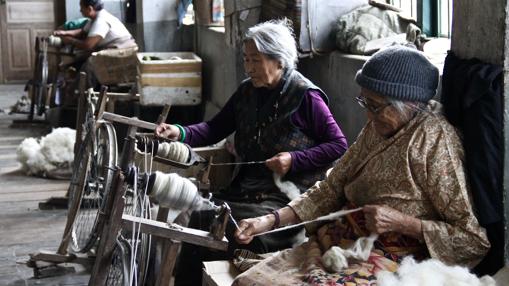
In these lands of 16 square kilometers, provided by the American Emergency Committee in the middle of the Darjeeling tea plantations, exiles live and work in a community that has 15 craft workshops where they make furniture, they weave rugs and paint «thangkas» (buddhist paintings) to make a living. «Before we wanted independence; Now we settle for greater autonomy and respect for our culture», recognizes Dorjee Tseten aware of China's growing international strength. Although he is convinced that «one day we will return to Tibet», Dolma and Sangmo, two old women who fled in 1959 and weave wool in a rudimentary workshop, They do not hide their bitterness because «we are stateless and we are alone, since we leave our country and our families. Many of them have already died and the rest we will never see again.».


