

By Annie Wu
11/03/2018
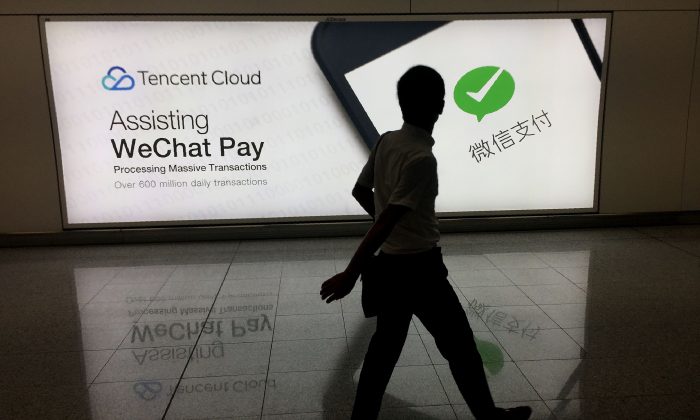 A man walks past an advertisement for social media platform WeChat at Hong Kong International Airport.
Kong, he 21 August 2017. (Richard A. Brooks/AFP/Getty Images)
WeChat is one of the most popular social media platforms in China, con 494,3 million individual users within China's borders at last count. for some, however, using it can be considered a crime.
Six Falun Dafa Practitioners, a spiritual meditation discipline that is severely persecuted by the Chinese regime, were recently arrested and detained for posting messages on WeChat about the regime's continued crackdown on the practice.
WeChat works closely with Chinese authorities to help censor content that the regime disapproves of. Information about Falun Dafa, also known as Falun Gong, It is heavily censored within China; a spiritual discipline based on universal principles Truth, Benevolence, Tolerance was prohibited in 1999.
The then leader of the Chinese Communist Party Jiang Zemin feared that the group's popularity - until 100 millions of followers, according to Western media quoting Chinese officials in 1999- would weaken the authority of the Party. In July 1999 launched a nationwide campaign to eradicate the practice, mobilizing the state security apparatus to arrest and detain practitioners, while state media spread hate propaganda to turn public opinion against practitioners.

Falun Dafa Practitioners Exercise in Beijing, before the chase started
he 20 July 1999. (Courtesy of Minghui.org)
It was confirmed that more than 4.000 Practitioners died as a result of torture and abuse while in detention, although the real number is believed to be much higher, due to the difficulty of getting information out of China, according to the Falun Dafa Information Center, the discipline's press office. She further , A large number of practitioners were killed through forced organ harvesting due to the organ transplant business authorized by the Chinese regime..
Despite violent repression, millions of Falun Gong practitioners continue to practice their faith, according to a report by 2017 from the human rights organization Freedom House on religious persecution in China.
Many try to spread information about the regime's persecution to ordinary Chinese citizens, who cannot access free information about Falun Dafa on the internet or anywhere else within the Chinese border.
This latest case is the regime's attempt to silence and punish these practitioners for their WeChat activity.. Four women and two men -Wang Hui, Wang Xin, Han Xiaoqiu, You Tingting, Wang Yong and Wang Dengli- from different cities and provinces were arrested and later detained in the Lishui City Detention Center in Zhejiang Province, according to Minghui.org, a US-based website that monitors the persecution in China. the police, Prosecutors and other Party agencies have since attempted to coerce the six practitioners into abandoning their beliefs., according to the Minghui report. He 20 March hearing scheduled at Songyang County Court.
In the case of Wang Hui, Plainclothes police officers pretended to be delivery drivers and took Wang Hui out of his house, and then they kidnapped her in May 2017. She was taken to the local police station and then transferred to the Songyang County Detention Center.. When her family members and a lawyer visited her to ask for her release, the detention center transferred her to Lishui Detention Center, and did not inform his family until 22 days later, according to Minghui.org.
China's Constitution guarantees freedom of religion, expression, meeting and protest. But the reality is that Falun Dafa practitioners and other dissidents continue to be detained for practicing their faith or spreading information..
The Freedom House report 2017 explained how Chinese authorities use surveillance technology and geolocation data to identify Falun Gong followers, locate them and gather “evidence”” against them. “Court documents and anecdotes provided by Falun Gong refugees illustrate the various and detailed types of evidence that authorities collect to convict practitioners.”, from videos recorded on a bus to Internet browsing history and mobile phone logs”, says the report.
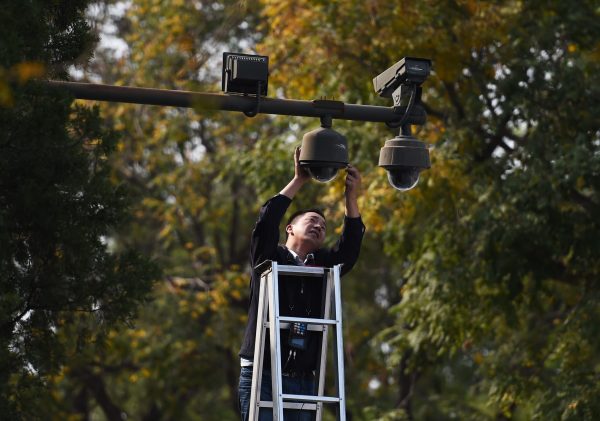
A worker adjusts security cameras at the edge of Tiananmen Square in Beijing
he 30 September 2014. (Greg Baker/AFP/Getty Images)
Freedom House analyzed a sample of 59 court verdicts involving Falun Gong practitioners in 2016, where everyone was sentenced to prison for accessing or publishing information: “His alleged ‘crimes’ included leaving voicemail recordings, send messages to social media platforms WeChat and/or QQ, use a virtual private network (VPN for its acronym in English) to download Minghui content, or simply possess a large number of pamphlets or records for alleged dissemination.”, says the report.
Internet censorship became increasingly severe during official Lu Wei's time as head of the Cyberspace Affairs Administration. Lu Wei was charged with corruption offenses and removed from office and Party membership in February..
Several Falun Gong followers were arrested and detained for posting articles about the Chinese regime's persecution online..
Huang Qian, of 47 years, For example, was arrested on 3 February 2015 for publishing a series on Weibo, the Chinese equivalent of Twitter, titled “Gulag Memoir” about the chase. Huang Qian was sentenced to five years in prison.
Zheng Jingxian, who also used Weibo as a platform to express his opinion, He was arrested that same day and detained in the Nanzhou Detention Center., in the southern metropolis of Guangzhou.


