

Read the original with all the photos here
Take a virtual visit thanks to this video from National Geographic
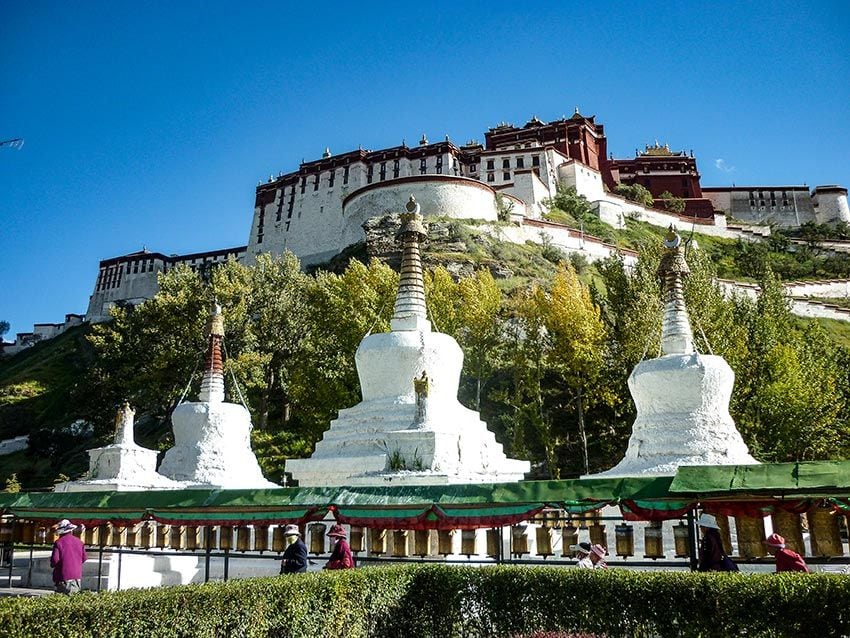
On the Red Mountain, dominating the city of Lhasa, the undisputed symbol of Tibet rises. A fascinating place in the highest country in the world that is the epicenter of Tibetan Buddhism and the ancestral home of its spiritual leaders, los dalai lama, the last of whom had to leave this Himalayan kingdom in 1959, a few years after being invaded by China. Over there, on high, in a place closer to heaven and divinity, The imposing palace began to be erected in the 7th century under the reign of Sontsan Gampo for his marriage to Princess Wencheng of the Tang Dynasty.. Destroyed by wars, It would be in the 17th century when, after fifty years of work, acquired its current form thanks to the fifth dalai lama, becoming the religious and political center of Tibet, in addition to the great masterpiece and maximum expression of ancient Tibetan architecture.
It is impressive to imagine how the stone blocks necessary for its construction could have been carried to the top of this cliff on Hongshan Mountain., what is marvelous today is the spirituality that surrounds it, where Buddhist priests follow ancient liturgical rites and the Tibetan pilgrims who move through it radiate solemnity and devotion. Unreality, vertigo and spirituality surround this outstanding work of an ancient culture.
DID YOU KNOW WHAT…
The Palace is the highest ancient building in all of Tibet and the highest on the entire planet., a 3.700 meters above sea level.
Its original structure was built in stone and wood and cast iron was introduced in its outer wall to make it more resistant to earthquakes., which has also contributed to its being able to reach our days.
At that time he was called «Red Mountain Palace» and the nine floors that it already had then contained 999 stays, plus the buddha hall.
More than a normal palace, as we know in the west, Potala is a place to pray, because it has many more prayer rooms than any other type.
The roofs of some of the buildings are made of copper and painted gold, designed with sunlight in mind.
The first thing pilgrims who arrive at this palace that seems to have grown out of the rock do is perform the kora. (circles around him). The most moved prostrate themselves before him and even cry for the exile of their inhabitant., el dalai lama.
The Potala Palace is declared a World Heritage Site along with the Jokhang Monastery –the most famous of Tibet's Buddhist temples–, and Norbulingka Palace.
The Potala Palace is the setting that inspired Martin Scorsese for his film Kundun, which received four Oscar nominations. Its plot recreates the life of a two-year-old boy recognized as the fourteenth reincarnation of the Dalai Lama who is taken to the palace to be prepared as a new political and spiritual leader..
ESSENTIAL
With dimensions of 400.000 square meters, of which some 130.000 they are built, and 13 stories high in its main body, Within it you can see the White Palace –with one area where generations of Dalai Lamas have lived and another dedicated to political affairs– and the Red Palace, in the central bud, where religious activities were concentrated. The yellow building houses the large flags with sacred symbols that are hung on the southern facade during the New Year festivals.
What were the personal quarters of the current Dalai Lama, the throne room of the 7th Dalai Lama, the sacred chapel of Phakpa Lhakang, the Chogyel Drupuk meditation cave or the stupa of the 5th Dalai Lama, with gold and covered with precious stones.
You also have to pay attention to the number of murals, statues, jade pieces, ceramics or gold and silver, countless liturgical utensils and historical documents of great value that it treasures in its rooms.
Before entering the labyrinth of rooms and chapels, The best places to photograph the complex are the square in front of it, the viewpoint behind the three white stupas and the back, with a large pond. Much better first thing in the morning, when the sun shines fully on the palace and illuminates it.
Furthermore, the Palace, In Lhasa you must see the old Tibetan quarter, with its markets and its labyrinth of alleys, owners of a medieval charm that has nothing to do with the bland new city. Don't miss the atmosphere of Barkhor, a circular street in old Lhasa through which Tibetan pilgrims walk and make their offerings with absolute devotion.
VERY PRACTICAL
To get to Lhasa, capital of the Chinese autonomous region of Tibet, where the palace stands, there are no direct flights. From Madrid or Barcelona you must first fly to one of the main Chinese cities –Shanghai, Beijing, Chengdu, Xi'an, Hong Kong, Chongqing–, with airlines like Air China, Finnair o KLM, with at least one scale, and from here to Lhasa. This journey can also be made from any of these cities on the famous trans-Tibetan train, also called cloud train.
You can only reach Tibet through an agency. Then the greater or lesser mobility and the routes are personalized, they adapt to measure to their clients. The most common thing is to be a minimum 15 days and include other essential places in China, from some 3000 €. Youlan Tours ( viajaraltibet.com) is a Spanish agency specialized in Tibet
The altitude at which the palace is located means that there is much less oxygen than usual in the air., Therefore, a visit to it will be recommended when one has already acclimatized to such a height..
To enter Tibet it is necessary to have a passport valid for at least six months., a visa and entry permit issued by the Tourist Office and processed with a travel agency. No vaccination is mandatory.
The best time to visit Tibet is from April to September. It should be taken into account that due to its location, Solar radiation is among the highest in the world.
VIRTUAL VISIT
Thousands of miles away, You can tour all the spaces of the Dalai Lama's ancestral home thanks to this National Geographic video


