

Original text: Political Solidarity with Tibet
The defense of Human Rights in Tibet becomes international. Two acts, one of a political nature in the Congress of Deputies of Madrid and another in Brussels, in which the Tibetan cultural genocide carried out by the Chinese Communist Party will be addressed, they remind us again today –World Refugee Day– the struggle of an oppressed people against their oppressor. Chinese repression continues and Buddhist monks continue their immolations, but the hope of seeing a free Tibet is still alive.
By Borja González Andrés for GEA PHOTOWORDS¿What is the Government that you represent doing to ensure that Human Rights are respected? (Human Rights) in Tibet?”. To this question, formulated by the deputy of the Basque Nationalist Party, Admit Esteban, The Foreign Minister of the Spanish government will have to respond today, José Manuel García-Margallo, during the Plenary Session of the Congress of Deputies.
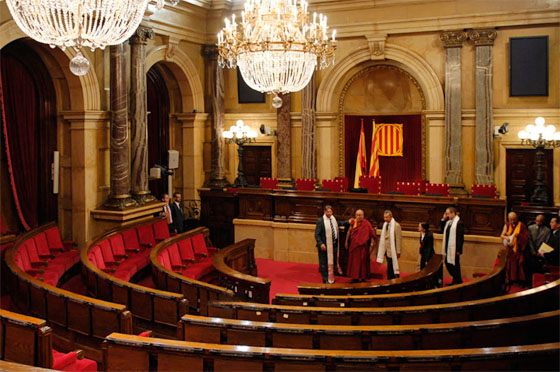
It will not be the only reference to Tibet made in the Palace of Cortes during the day. Already in the afternoon, starting at five, the parliamentary intergroup for the promotion and defense of human rights will receive Thubten Wangchen, director of the Fundació Casa del Tíbet of Barcelona and deputy for Europe of the Tibetan Parliament in exile.
“It is about taking advantage of World Refugee Day to explain the current situation in Tibet in Parliament.”. I think that the fact that Spanish deputies, headed by the representative of Convergencia i Unió, Carles Campuzano, "Meeting with me already means something.", Wangchen points out..
“In a country like Spain, where none of the democratic presidents have officially received the Dalai Lama for fear of China's response, This act can serve as an approach. And that's why, as a token of gratitude and cordiality, I want to offer you my khatag, our silk scarf [of the Tibetans]”
The reception to Wangchen is part of the Day of Solidarity for Tibet. one day, organized by the International Network of Parliamentarians for Tibet (INPaT), which aims to raise awareness among political representatives around the world about the dramatic situation experienced by the inhabitants of the territory occupied by China, including the dozens of immolations that many monks have carried out as a symbol of desperation during recent months.
It is estimated that since March 2011, more of 35 Tibetan religious, most young, they have caught fire. These acts, which usually occurred in provinces bordering occupied Tibet or in the vicinity of monasteries, They have already arrived in the capital, Lash.
He 27 of May, coinciding with a massive religious celebration in the city, two young people immolated themselves in front of the Jokhang temple. one died, and the other was seriously injured. Since then, Chinese security forces have multiplied in the capital. Some sources - one of the few that have access to what is happening in the area- They speak of hundreds of arrests and expulsions from Tibetan territory. days later, The Beijing government imposed a ban on individual foreign citizens visiting Tibet., and established a minimum capacity of five people (of the same nationality and under the supervision of a Chinese guide) so that they could access the territory.
In this context of tension, INPaT calls on democratic governments to urge the Chinese authorities “to receive the United Nations High Commissioner for Human Rights, so that he can carry out a fact-finding mission in Tibet, including the Tibetan areas where many of the immolations have taken place.".
Also in Brussels
The community capital will also today be a meeting place for demands regarding Tibet. In this case, about the cultural genocide that is taking place in the region, according to a report issued by the International Campaign for Tibet (ICT).
Since the 10.45 hours, several experts will examine the impact on Tibetan culture that the domination of the Chinese Communist Party has had for more than six decades. Among them will be Alán Cantos, director of the Tibet Support Committee (CAT), who already introduced us in GEA PHOTOWORDS to one of the witnesses whom Judge Ismael Moreno called to testify at the National Court in relation to a possible genocide committed in Tibet.
That witness, the American doctor Blake Kerr, witnessed abortions, forced sterilizations, torture and infanticide during his stays in Tibet between the years 1987 and 1999, as he said in this interview.


