

A CONTROVERSIAL LEGISLATIVE MODIFICATION
- The Constitutional Court will soon address an appeal against the end of universal justice in Spain
- The court will review the file of a case that questions the legal reform of the Rajoy Government
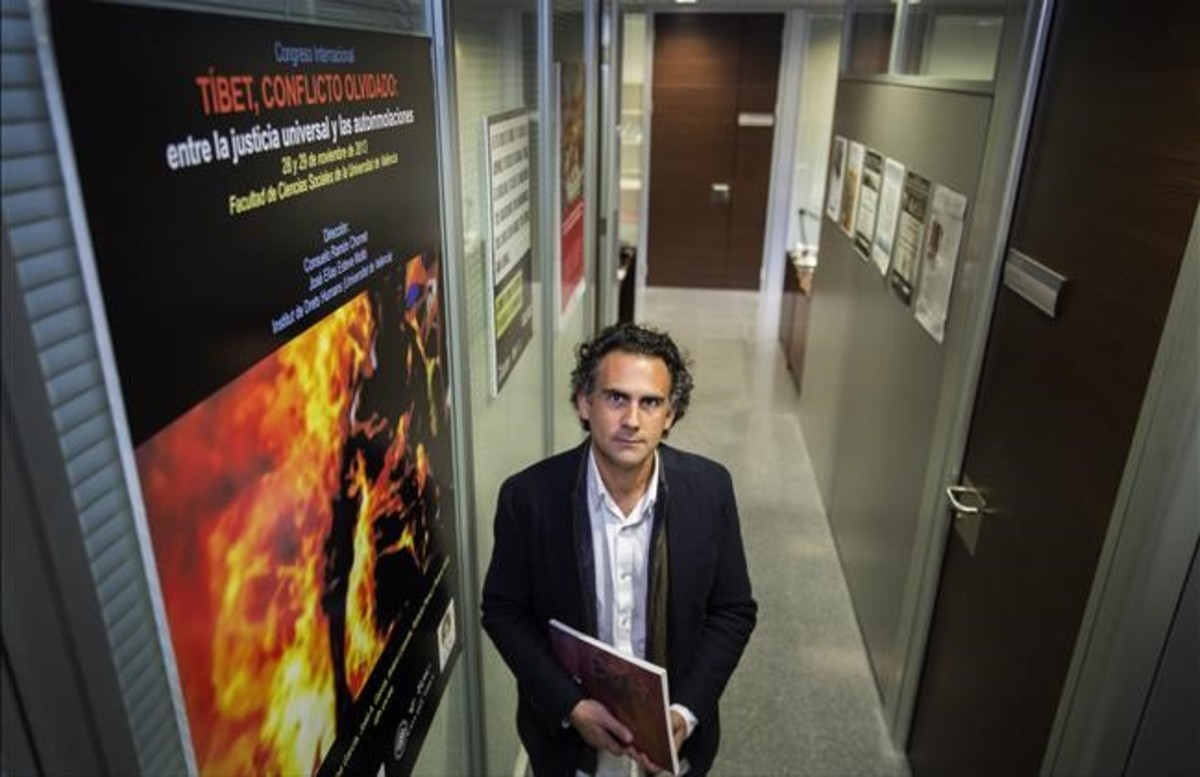
MIGUEL LORENZO
José Elías Esteve, Professor of Law at the University of Valencia, driver of
recurso contra el archivo del 'caso Tíbet'.
SATURDAY, 15 APRIL OF 2017 – 10:00 CEST
The Constitutional Court will shortly review the file of the 'caso Tíbet' and , with the, the reform of the law that in 2014 ended the concept of universal justice in Spain, which allowed Spanish judges to investigate and prosecute crimes committed outside the country. After his appeal for the closure of his case was admitted –for which former Chinese presidents were charged Jiang Zemin and the former prime minister Li Peng–, the Tibet Support Committee, the House of Tibet in Barcelona and its president, Thubten Wangchen, They presented their legal arguments and asked that a ruling be also made on the appeal to the rule that the PSOE presented at the time and that had been left on hold..
José Elías Esteve, Professor of Law at the University of Valencia, is one of the drivers of the resource and, although he admits that “no one gave a cent anymore” for its admission to processing, believe that, barrier to entry overcome, They have many options for it to prosper. “There are solid legal arguments”, Explain, and bases its hopes on two previous rulings of the Constitutional Court itself, la del 'caso Guatemala' en el 2005 y el 'caso Falung Gong' in it 2007.
“In them there is a radical argument in favor of universal justice. Doesn't leave a single crack, openly says that we must pursue this type of international crimes because if we do not return to a state of international law prior to the Second World War, and that cannot be, explains Esteve. For this lawyer, The Constitutional Court will have a very difficult time backing away from its own arguments, although it assumes that many of its members have changed their position.
THE CHANGE OF COUNT PUMPIDO
“When he came out self processing Pinochet, all the judges of the plenary session of the Criminal Chamber were in favor of an absolute interpretation of universal justice, but in 15 years and there are only four judges who think like this”, regrets Esteve. A path that has been traveled Candido Conde Pumpido, one of the four new members of the Constitutional, something that worries them a lot: “He was the speaker in the Supreme Court of the ‘Guatemala case’ y dijo radicalmente lo contrario que ha dicho ahora en el Supremo para confirmar el archivo del ‘caso Tibet’".
When he was appointed State Attorney General He began to change his speech and Wikileaks “We learned about things he had done, such as meeting at the American embassy.”, slide. Esteve hopes that in a few months there may be a ruling and announces that if it is favorable to them, “The first thing we would ask is that the international arrest warrants be activated again”. Among them were those of Jiang Zemin and Li Peng, which were the ones that provoked the furious Chinese reaction.
Esteve believes that a ruling in that sense would also mean the reopening of cases like that of José Couso and “it would force us to redo that law or return to the previous state”. A ruling against it would not end his hope either.. On the one hand, for the bill recently presented by ERC to return to universal justice “and which they say the PSOE and Podemos will support”, point. Y, for another, because they still have the Human Rights Court of Strasbourg and the possibility of activating the complaint from another country.
A REFORM TO THE TASTE OF CHINA
The reform of 2014 assumed, according to Esteve, two big rights cuts. One is the effective protection of the victims. “That a case be retroactively archived when there were orders of international arrest “It was an aberration.”, judgment. And the other is the impossibility of presenting complaints of universal justice through popular action. “That is a flagrant violation of the Constitution”, state.
Esteve admits that a government has the political power to do legislative changes but remember that there must be “legal coherence” and if it continues, the government should send “the letters that are needed to the Secretary General of the UN.”” to announce the country's withdrawal from conventions against genocide o war crimes, because they force us to persecute them universally. The professor assumes that the inspiration for the reform of 2014 arrived from China.
“The reform is basically done because deputies from the Chinese assembly and in the foreign commission of Congress they read the primer to everyone. We have been told by deputies who were there and by the Minister of Foreign Affairs [José Manuel García Margallo] At the time he recognized on television that the reform was carried out under pressure from China. "They haven't hidden it.", argues. In fact, is convinced that that long but effective 'transmission belt’ It will have already been activated again with this resource.


