

The former Maoist guerrilla ended up defending the political line of the Dalai Lama and spent almost two decades in solitary confinement
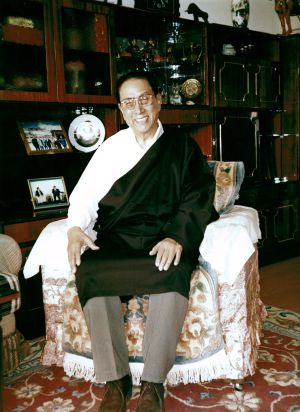 Photo: Phuntso Wangye, Tibetan communist leader and
CCP dissident. / REUTERS
Phuntso Wangye —o Baba Phuntsog Wangyal—-, veteran Tibetan leader member of the Chinese Communist Party (CCP), who acted as an interpreter between the Dalai Lama and Mao Zedong and later criticized the CCP's policies in Tibet, died at the end of last month at 92 years. The Dalai Lama expressed his “deep sadness” in a statement." for the death of someone he considered “ “a trusted friend”.
Wangye, born in 1922 in the Tibetan county of Batan, in the Chinese province of Sichuan, He founded the Communist Party of Tibet in the 1930s., which would later merge with the CCP, and promoted a series of guerrilla uprisings against the then nationalist Chinese government until he joined forces with Mao Zedong's communists in 1949. He led the troops of the People's Liberation Army when they entered Tibet in 1951 and played a key role in talks between the central government in Beijing and the Dalai Lama in the mid-1950s, when he served as an interpreter between Mao Zedong and Zhou Enlai and the Tibetan spiritual leader.
The Dalai Lama says he met Phunwang in 1951, when he accompanied communist leaders to Lhasa. "Then, during my visit to Beijing and other cities in 1954-1955 He assisted me and served as an interpreter and we became good friends.. During the series of meetings I had with Mao in particular, was a crucial help as my interpreter. He was learned in Marxist thought and much of what I know about this I learned from him.. He was one of those Tibetans aware of the drawbacks of the predominant social and political system in Tibet., who was inspired by communism to bring about change.”.
The Tibetan religious leader recalls in the statement how, in his first meeting with the Chinese delegation, He was caught by surprise when Phuntso Wangye decided to prostrate himself before him.. He also says that while all the members of the Chinese group were dressed uniformly in Mao-style suits, Phuntso used the chuba, traditional tibetan costume. "When I asked him about this, told me that it would be a mistake to think that the communist revolution was primarily concerned with how to dress. He said that it was more of a revolution of ideas and that he did not believe that being a communist meant that a Tibetan should reject Tibetan traditions.. The Dalai Lama fled from Tibet to India in 1959 after a failed uprising against the Beijing Government.
Phuntso Wangye was imprisoned in 1960 for his Tibetan nationalism, and spent almost two decades in solitary confinement, which perhaps avoided a more tragic fate during the Cultural Revolution (1966-1976). “Phuntsog Wangyal”, continues the Buddhist religious leader, “he remained undaunted and even after retirement he continued to care about the rights and well-being of the Tibetan people, something he raised with Chinese leaders every chance he got.".
in 1978, already with Deng Xiaoping in power, His CCP membership was returned to him and he was rehabilitated. Thereafter,, He turned down the opportunity to become president of the Tibet regional government and became increasingly critical of Beijing's position toward Tibet and the Dalai Lama.. He was a defender of the so-called “middle way.”” proposed by the Dalai Lama as a pragmatic solution to the Tibetan problem, an alternative that defends genuine autonomy instead of independence.
Phuntso Wangye's death coincided with the mass immolation of a Tibetan nun in Kardze Tibetan Autonomous Prefecture, en Sichuan, according to the Free Tibet group and Radio Free Asia. It was the third incident that occurred that month., after two Tibetans died in Sichuan on 16. March is a sensitive month in Tibet and Tibetan areas in China, such as Sichuan and Qinghai provinces: The Tibetan popular uprising occurred on 10 March 1959. At least 125 Tibetans have immolated themselves in China since 2009, according to the same sources.
Phuntso Wangye wrote letters to former Chinese President Hu Jintao on several occasions., in which he criticized CCP leaders in Tibet for using a so-called anti-separatism campaign to achieve their own political goals and for failing to recognize the Dalai Lama's role in Tibetan society..
The former intermediary between Beijing and the highest Tibetan religious leader also urged Hu Jintao —who knew the situation in Tibet well, since he was secretary of the communist party in this autonomous region in the eighties— to allow the Dalai Lama to return to Lhasa because, as he said, This would contribute to the stability of the region. After Hu retired in March 2013, Wangye continued to urge the new president, Xi Jinping, to reconsider Beijing's policies in Tibet, according to the dissident Tibetan writer Tsering Woeser. The Dalai Lama assures that Wangye “was a sincere and honest man. I enjoyed your company every time we met.. I hoped we could see each other again., pero no pudo ser". The Dalai Lama has not returned to Tibet since taking refuge in India.


