

An Indian engineer creates artificial glaciers inspired by cult monuments to combat drought in the Himalayas
JORDI ALBACETE
Yes (India) 8 MAY 2018
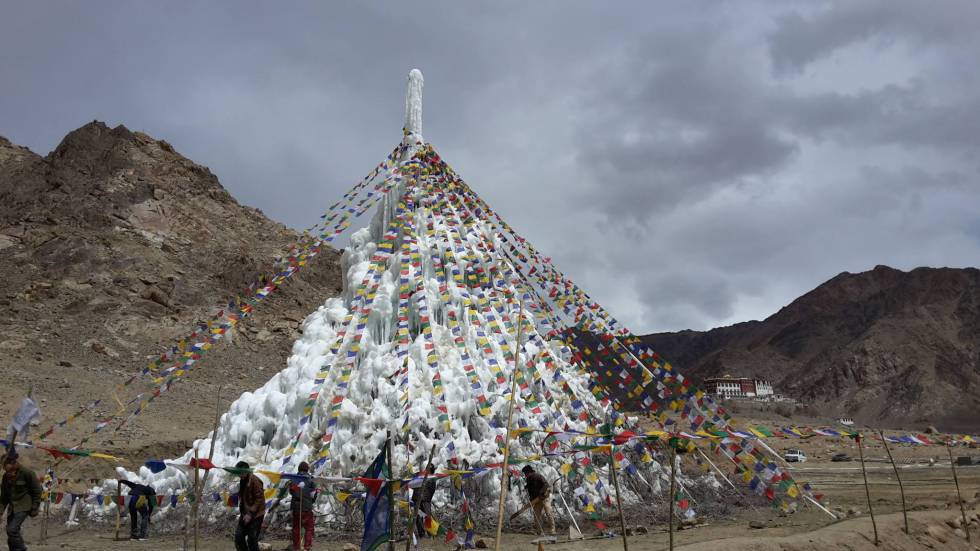 Ice Stupa near Phyang Monastery, Ladakh, in April 2016. ICE STUPA PROJECT.
India always offers examples of adaptation to the most adverse natural environments. In June, after eight long months of winter, the roads of ladakh, in the extreme northwest of the country, colossal blocks of ice are freed. To more than 3.000 meters high, The vegetation disappears and the rocks are exposed before challenging cliffs. The roars of the wind are the only sound in these desolate lands of exuberant beauty. The only notes of color, for many kilometers around, They are Buddhist prayer flags and sparse white monasteries raised capriciously between rocks.. The culture and landscape of Ladakh are practically identical to those of the Dalai Lama's land.
This little Tibet opens to tourists, mountaineers and mystics thirsty for high mountain landscapes, buddhist festivals, meditation and extreme sports. Most are unaware that local farmers are battling the effects of an accelerated deglaciation that puts their subsistence at risk.. They also ignore new local inventions to adapt to the effects of climate change. Among the most recent, there are the ice stupas, sacred monuments used as frozen water reserves for irrigation.
Jean Paul is an experienced French traveler who knows Tibet well and is passionate about the Ladakhi region.. last summer, when visiting Tsokar Lake, one of the favorite places for observing migratory birds, got an unpleasant surprise: the lake was practically dry. As the locals explained to him, It was the first time they saw him like this. The black necked crane, a mythical bird in Tibetan Buddhism, was absent, and only a few wild donkeys prowled around what was now a dry wetland. Jean Paul's surprise could be explained by the combination of decreased snowfall and a sustained increase, very important, of temperatures.
In Ladakh, one of the places in the world furthest from industrialization, The temperature has risen two degrees since 1980. It is the same increase as, compared to pre-industrial levels, the international community committed to avoiding by the end of this century, at the Paris summit 2016. Despite the fact that a leader like Donald Trump withdrew his country from the agreement.
Without water there is no wildlife and, if you don't arrive on time, agriculture is not possible either. In Ladakh, Human settlements have adapted for centuries to have water from melting glaciers at the beginning of spring.. So, farmers have just enough time to plant before the torrid summer heat arrives and harvest before temperatures plummet below 30 negative degrees. As the glaciers melt, These retreat to higher levels. There they remain refrigerated for longer and thaw at the end of spring.. Too late for farmers.
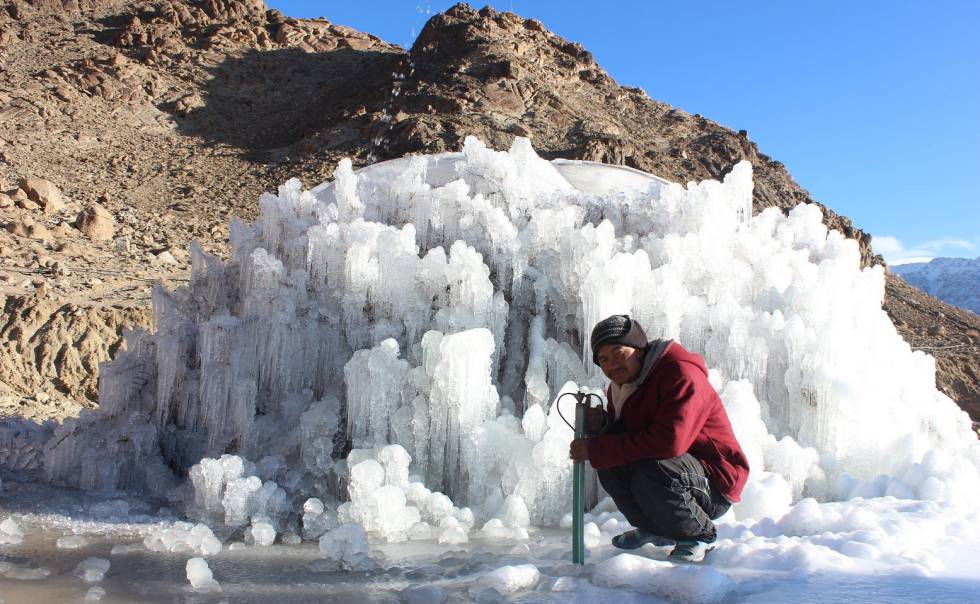
construction. ICE STUPA PROJECT
Tenzin, He is one of the peasants of a small village of Markha, a narrow valley where the mighty Zanskar River, a tributary of the Indus, It winds between precipices of reddish rocks and where the only life that appears from the heights is that of the vigilant blue goats of the Himalayas.. Tenzin sees it as very difficult for young people to continue with the agricultural tradition if it continues to snow less and understands, resignedly, that young people leave the villages.
Life in Ladakh requires an extraordinary capacity for adaptation, and climate changes are extreme. Although the increase in temperatures produces drought at the beginning of spring, It also involves excess water in summer. In June, when temperatures are higher than usual, the melting of glaciers accelerates. Huge blocks of ice melt quickly and overflow the rivers, forming glacial lagoons.. This stagnant water is very dangerous: in 2010, A sudden storm overflowed some glacial lagoons and flooded 71 pueblos, including the capital, Yes. 255 people died after this catastrophe
The solution: an ice cream cone
Deglaciation and its impact on agriculture became Sonam Wangchuk's obsession, a Ladakhi engineer and educationist. It wasn't the first: in the late nineties, Another local engineer named Chewang Norphel was already creating large frozen lakes on the slopes of high mountains by diverting streams. But Norphel had an obstacle to bringing these reserves closer to the villages: the height. Fascinated by this innovation, Wangchuk set out to overcome the obstacle.
A patch of ice under a bridge on a sunny May day gave Wangchuk the clue.: the ice was preserved by the shade despite the heat. That image inspired him to design a conical structure where the ice casts its own shadow.. “The wide base of a cone allows more ice surface to shade itself.” (…) As flat glaciers melt in days, a conical one can take weeks” , explains Wangchuk in The monk promotional video, the engineer and the artificial glaciar (The monk, the engineer and the artificial glacier).
Technology and sustainable development
On the banks of the Indus River, hidden among vast desert esplanades, near the village of Phey, Secmol residential school is located, founded by Wangchuk in 1988. Its admission criteria is very peculiar: having failed in some other school. Among traditional adobe buildings, solar ovens, greenhouses and orchards, many young Ladakhis learn a trade to develop their villages sustainably.
It is there where Wangchuk has developed ice stupas with his students. In a class recorded for an AlJazeera documentary, The teacher explains to his students with a hose pipe and a bucket full of water how to build an ice stupa. The bucket is placed on top of a slope and, the hose is used as a siphon. Wangchuk turns a corner and the water gushes upwards, “when it falls and comes into contact with the wind of 20 negative degrees freezes”, describes the teacher.
The cube of water represents a stream 60 meters high, which branches through a pipe, represented by the hose tube. The pipe runs almost three kilometers underground to the base of the stupa; There its only exit is through the vertical pipe of 15 metros, the bent section of the hose. At its end there is a sprinkler so that the water, when falling, create a broad base.
When temperatures drop mercilessly between December and January, Wangchuk's team gets going. They work at night to take advantage of the freezing temperatures and darkness so that ice forms quickly.. In a matter of weeks the stupas reach 25 meters high and a capacity greater than 150.000 liters. The objective is that they can supply water for irrigation to the fields from March to May, “critical months for sowing”, says Wangchuk for the Indian channel Factor Daily.
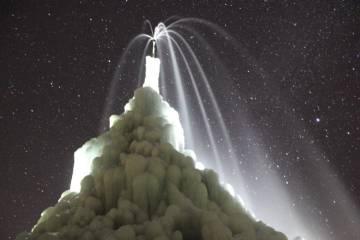 An ice stupa, at night. STUPA PROJECT
OF ICE
But there are more objectives: create an alternative university, the Ladakh Himalayan Alternatives Institute. A center where scientific solutions will be sought to the problems of adaptation to climate change in the Himalayas. Its future campus already has 5.000 trees, irrigated by the melting of the stupas and that were planted in 2015 for a thousand people, including locals, monks and soldiers. The immense, arid valley around Phyang begins to turn green.
Local tradition and global challenges
Spirituality vibrates in this land of slats. The Dalai Lama spends his summers in Ladakh, where he brings together crowds in his spiritual teachings. The Ladakhis and the seven thousand Tibetan refugees live their daily lives in a mystical connection with their environment. Every year the villages summon an astrologer to choose the auspicious day for planting.. Before starting, a ceremony is held to appease the water and earth spirits who may become angry when the stone is crushed, irrigation canals are plowed or opened.
This mystical relationship is what motivated the design of the ice stupas.. This is how Suryanarayanan Balasubramanian explains, mathematician and member of Wangchuk's team: “The similarity with the stupas is not accidental and allows them to be integrated into the landscape and culture of the towns”. An integration also appreciated in the West. Its innovative design earned it the prestigious Swiss Rolex Business Award in 2016 and Glasgow University professor Sean Johnston, specialized in technology and environment, opina que las estupas de hielo "son un ejemplo de “cómo la tecnología puede ayudar a la adaptación al cambio climático incluyendo valores locales".
A sacred dimension is what distinguishes these artificial glaciers from many other adaptations to climate change. in 2015, when was the first stupa built, Lama Drikung Kyabong Chetsang Rinpochey was invited for its inauguration, one of the most important lamas in Tibetan Buddhism. The frozen stupa was decorated with prayer flags and entrusted with mantras.
Chetsang Rinpochey encouraged the export of ice stupas wherever they could be useful. In fact, Some monasteries have not been slow in trying to produce frozen stupas with their own means, although it's still early, ya que "aún se están haciendo ajustes en la fase piloto", comenta Suryanarayanan. She further , Wangchuk's team has already taken the stupas to the Alps and Andes to look for applications in draining water and generating power from new glacial lakes..
between the 18 and the 23 In March, the International Water Forum and the International Alternative Water Forum were held, in Brasilia, and water access policies dominated the debates. The challenges of climate change represent new opportunities, even for those who, like the Ladakhi peasants, they have not contributed to their causes.
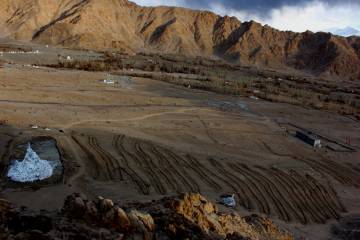 To the left, stands out an ice stupa in the middle
desert landscape. ICE STUPA PROJECT


