

Six decades after the entry of Chinese troops into Lhasa, The community that fled to northern India and organized its own authority in exile remembers those days
(Read original article)
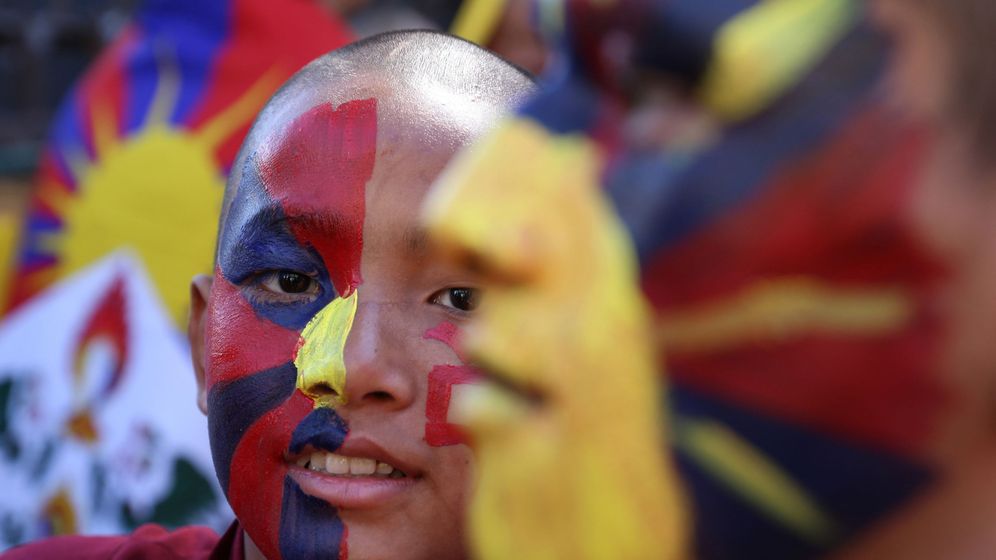
Tibetan exiles in Dharamsala, India, participate in a peace march during the 60º birthday
of the Tibetan National Uprising. (EFE)
18/03/2019
The war came to Lhasa, capital of Tibet, in the early morning of 19 March 1959. “The shooting and shelling stopped on the night of 20. So, The Chinese authorities demanded the surrender over a public address system., threatening to multiply the attacks if we resisted”, describe Lobsang Yonden, of 77 years and witness of that invasion just 60 years. “My father was meeting with aristocrats when the people of Lhasa took to the streets with white flags to prevent the total destruction of the Potala Palace.”, recalls Yonden from his home near the main Buddhist monastery in the city of Dharamshala, in India, where he has lived for decades with several hundred Tibetan monks and exiles..
The small city in the foothills of the Indian Himalayas is today the refuge of one of the largest settlements of the hundreds of thousands who fled Tibet after the invasion and war with China., like Lobsang Yonden himself, arrested at 16 years for participating in the uprising. “When they stopped us, His Holiness [the Dalai Lama] “I had already escaped the siege but only my father and a few other representatives of the people of Tibet knew about it.”, remember. Towards the end of March 1959, Tenzin Gystaso, the 14thº Dalai Lama, greatest religious figure of Tibetan Buddhism, safely crossed the border with India and settled in Dharamshala, where he created the Central Administration of Tibet (CTA), also known as the Tibetan government in exile, and place where exiles, Refugees and supporters of the cause remember the occupation annually.
“When the People's Liberation Army (EPL) de China marchó por primera vez en Tíbet prometieron construir 'una carretera' que traería 'paz y prosperidad'. But once it was built, tanks, "Chinese army guns and soldiers completely occupied the Tibet plateau.", He started saying Lobsang Sangay, 'sikyong' (conductor) of the Tibet government in exile, in his official speech last 10 March before delegations from European countries gathered in Dharamshala to commemorate the Tibetan uprising against the Chinese invasion. in 2011, and as a consequence of the Dalai Lama's resignation from his role as political leader, Sangay was democratically elected the highest representative of the Tibet government in exile.
This anniversary takes place shortly after China banned the entry of foreign visitors to the Tibet region., until early April, before the expected protests of the local population. Last January, however, The Asian giant announced the increase in the number of tourists in Tibet and the reduction of the procedures necessary for granting visas. The decision was preceded by pressure from the US, whose congress approved the Law on Reciprocal Access to Tibet in December 2018; which restricted the access of Chinese citizens to US soil with the aim of China facilitating visits by American journalists to report on the situation in Tibet, a region controlled militarily for decades.
Since the troops of the Chinese Communist Party occupied Tibet in 1950, Beijing has controlled the region with an iron fist. Human rights activists denounce widespread restrictions on ethnic Tibetans while Human Rights Watch annual report (HRW) points out that the Chinese administration uses “a nationwide anti-crime campaign that encourages community members to report the slightest suspicion of reverence and support” the Dalai Lama. For your part, the United Nations Human Rights Council (Ohchr) said in June 2018 that conditions were “deteriorating rapidly” in a region considered by Freedom House among the least free in the world. According to the International Campaign for Tibet (CIT), 155 Tibetans have immolated themselves since 2009 in response to abuses by the Chinese authorities that administer the region, including arbitrary arrests and torture.

Tibetan activist Lobseng Yonden. (A. L. Martínez)
The failure of universal justice
The septuagenarian Lobsang Yonden was one of many detained and tortured by the Chinese authorities. His father, one of the representatives of the people of Lhasa during the uprising makes 60 years, He was transferred to one of the harshest prisons in China along with other 53 prisoners, of which only 11 they came back. Although he was barely fifteen years old, Yonden was also a political prisoner during 10 years, accused of rebellion. “As my sentence was pending review, I was released at the beginning of March 1969. So I wrote a letter demanding the liberation of Tibet and they locked me up again. 1972 y 1973”, explains while detailing beatings and humiliations. Towards the end of the years 70, Chinese oppression in the region was reduced and diplomacy allowed some to travel to India and be welcomed in many of the Tibetan settlements that exist in various places in the north of the country.. From 1984, Lobsang Yonden vive en Dharamshala; where he worked for the Central Administration of Tibet (CTA) during 24 years, until his retirement.
In the wake of abuses against the Tibetan population, the Spanish lawyer José Elías, together with the Tibet Support Commission and the Casa de Tíbet Foundation, filed a criminal complaint against the Chinese Communist Party before the National Court in 2006. The complaint described crimes against hundreds of Tibetans who died of torture and starvation among 1971 – when the crime of genocide was included in the Spanish penal code – until 2005. So, in 2013, and based on the same principle of universal justice by which Spanish jurisprudence acted against soldiers of the Argentine dictatorship, Israeli army officers, American soldiers in Iraq and against former Chilean dictator Augusto Pinochet, An international search and arrest warrant was issued against several members of the leadership of the Communist Party, including the former Chinese president and former prime minister. in 2015, however, The Popular Party government reformed the Universal Justice Law, causing investigations into the genocide in Tibet to be archived.
Just as Spain's economic agreements with China truncated the judicial process to untangle the Gordian knot in Tibet, Its southern neighbor also feels the pressure of the Asian giant. In March of 2018, India banned the march organized annually by the Tibetan community in its capital; given Delhi's desire to bring closer positions with Beijing. After 60 years, the status quo in Tibet –where human rights violations are condemned without sanctioning the official position of powerful China– diminishes the desire for the future of Tibetan youth, that questions the official position of the government in exile.
In the first half of the decade of the 80, the Dalai Lama, then still political leader of the Tibetan government, The official position changed and went from demanding independence to asking for “genuine autonomy.”” of the region as part of China. The decision coincided with the cooling of the Chinese yoke and allowed the departure of Tibetans like Lobsang Yonden: “Aceptamos la 'vía intermedia' because China is not going to compromise its territorial integrity. But the conditions have now worsened again even though we Tibetans do nothing”, explains why he was a political prisoner, who trusts in autonomy as the only solution to the stagnation of the situation. Not so many of the young Tibetans born in exile, who do not see that China's stance has softened in the face of greater acceptance by the international community and, even, They question the viability of the policy defended for four decades by their religious leader, the Dalai Lama.


