

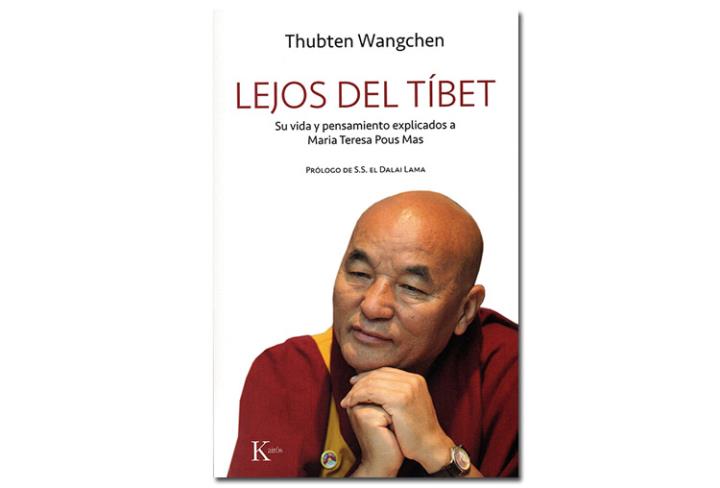
Through the good offices of Maria Teresa Pous Mas, Far from Tibet* (Editorial Kairós), Lama Thubten Wangchen, visible face and soul of the Tibet House in Barcelona, explains his life and thought.
With a foreword by the Dalai Lama (In his account, Lama Thubten Wangchen gives thanks several times for being able to study at the Dalai Lama's personal monastery in Dharamsala and for having received so many lessons directly from this spiritual leader), the testimonial story Far from Tibet begins with a foreword by Maria Teresa Pous to gradually unravel in the chapters: Goodbye to Kyirong. From living in the Valley of Happiness to begging on the streets of Kathmandu (the mother of the boy Thubten was murdered by the Chinese when he was five years old); Schools for Tibetan street children; At the Dalai Lama's personal monastery. Life and study; Dharamsala. Nature, animals, cultural life; Tibetan Buddhist philosophy; Far from the monastery. Make Tibet known to the world; The House of Tibet in Barcelona (Tenzin Gyatso, the Dalai Lama, it was inaugurated by 19 of December of 1994, and it was the Dalai Lama himself who advised the Tibet House to be in Barcelona); The Tibetan Government in exile (the Lama Wangchen is a parliamentarian of this government in exile).
As close as possible, the more it focuses on the tragedy of Tibet, more dear to us are Tibet and the Tibetans. We heard about it here through acquaintance, in my personal case, from such an extraordinary teacher as Professor Ramon N. prats (among other translations of classic texts he is the author of El libro de los muertos tibetano, an accompaniment to the souls when they make the transfer), and more specific publications about today's Tibet that have brought us closer to what Lama Wangchen himself says that with a partial view we would only see in a negative way. Testimonial publications such as that of the renowned Tibetan writer Pema Bhum in Six stars with a crooked neck. Tibetan memories of the Cultural Revolution [chinese], as well as the well-documented History of the Tibetans. From the historical origins to the current political conflict, by Josep Lluís Alay (also author of the Catalan-Tibetan bilingual dictionary), and journalist Philippe Broussard's account of Les rebels de l'Himalayan, in which he explains the terrible vicissitudes of two Buddhist nuns: la Kyzom i la Yangdöl, which for having shouted in Lhasa "Long live free Tibet” they were imprisoned and tortured by the Chinese.
In all these stories, and in the same account of Lama Wangchen, what he admires about Tibetans and the experience of Buddhism that is their own, it's this trying to always turn things around to try to solve problems and consciously practice compassion. Which is not how it is understood in the West: a form of empathy and solidarity, rather, it goes further to constitute an action determined to take care of the other, especially in that area that is so difficult to distinguish: the interior. That is why the inner vision is needed: the wisdom.
In the chapter in which Lama Thubten Wangchen talks about Tibetan Buddhist philosophy, takes a poetic figure to explain the combination of these two human qualities: compassion and wisdom. I translate his words: "In Buddhism we advocate equality between women and men. For us the energy of women symbolizes wisdom and the energy of men symbolizes compassion. To reach the state of perfection we all need the same strength of compassion and wisdom. Birds need two wings to fly, with one alone they could not fly. In the same way, we need the wing of wisdom and the wing of compassion.”
After arriving Far from Tibet of Lama Thubten Wangchen, we can agree with Richard Gere when he states that Tibetans seem to live ten lives for every one of ours. Indeed: it's not about living more or less years, a projection of the Western mind, but to live each day with depth.
Teresa Costa-Gramunt
*The edition in Catalan, Far from Tibet, has been published by Viena Edicions.


