

BBC 4 February 2015

¿China may be rehabilitating Tibetan Buddhism?
There are new signs that show that, despite the fact that the repression against Tibetan nationalism continues, The atheist state seems to be softening its position on religion, and even with respect to the Dalai Lama.
Most foreign journalists in China would find it unlikely that a former senior Communist Party official would invite the BBC to his home..
Especially if that official was rumored to have close ties to the Chinese leadership and had worked closely with the country's security services..
But it is harder to believe that this official later invited the BBC to see him praying in front of a portrait of the Dalai Lama..
However, That was exactly what Xiao Wunan did..
Inside Xiao's luxury apartment in Beijing, in a prominent place in the middle of his private Buddhist oratory, there is a photo of the exiled Tibetan spiritual leader, a man hated by the Chinese government who see him as a dangerous separatist.
For Tibetan monks, Even owning a photo of the Dalai Lama carries risks.
Exhibiting his portrait in monasteries is prohibited.
but there, under the same image, was Xiao with the Tibetan Buddhist guru Geshe Sonam.
The guru made it clear that he was not willing to talk about politics or the Dalai Lama.
But for Xiao, of 50 years, there was no major problem.
"En cuanto a los problemas políticos entre el Dalái Lama y China… casi no le ponemos cuidado", assures.
"Es muy difícil para nosotros juzgarlo desde ese ángulo. as buddhists, solo le ponemos atención como parte de nuestra práctica religiosa".
Attraction for the wealthy
Xiao was introduced to the BBC by a Chinese businessman, Sun Kejia, of 36 years, one of a supposedly growing number of wealthy Chinese drawn in recent years to the mysticism of Tibetan Buddhism.
The growing popularity of religion in general in China has been well documented and is frequently explained in terms of rapid Chinese economic expansion..
Millions of Chinese today may have the wealth that previous generations never dreamed of, but economic growth has been accompanied by seismic social changes.

"Alguna vez me vi confrontado por grandes problemas en mi negocio", dice Sun.
"Sentí que no podían ser superados por el esfuerzo humano, and that only Buddha could help me, los espíritus y Dios".
So Sun became a believer in the Tibetan monks.. Since then, He has amassed a fortune that he estimates at more than US$100 million.
He now runs a chain of Buddhist clubs and pays out of his own pocket for Tibetan gurus like Geshe Sonam to come and preach..
After the influence
Sun's guests, which include businessmen and party officials, find spirituality. He is looking for something different.
"Lo que quiero es influencia", assures.
"Mis amigos que vienen aquí se sienten atraídos por este lugar. I can use the resources they provide for my other business. From that point of view, It is also my contribution to spread Buddhism. Esto trae buen karma y así yo consigo lo que quiero".
And it seems to be working.

Sun invites us to meet other well-connected individuals who use their club.
Sitting on the floor with Geshe Sonam is a woman who, according to Sun, She is related to members of the highest levels of Chinese politics.
She and her companion are setting clocks, rosaries and necklaces in the middle of a circle for Geshe Sonam to bless them.
After the religious ceremony comes a luxury banquet.
The monk later admits to being a little uncomfortable with the whole thing..
Active promotion
"A veces toma tanto tiempo y realmente siento que estoy perdiendo el tiempo. But this can also be a way of preaching. If I don't go here, or I don't go there, ¿It would be better if I stay in a cave and never come out?", assures.
Buddhist monks need money and tens, maybe hundreds, are now hunting for funds in China's big cities.
Considering that China is still, officially, an atheist country, that may seem strange, especially due to the links between Buddhism and political activism in Tibet.
China, however, not only is he allowing this Buddhist evangelization to take place, but now you may be actively promoting it.
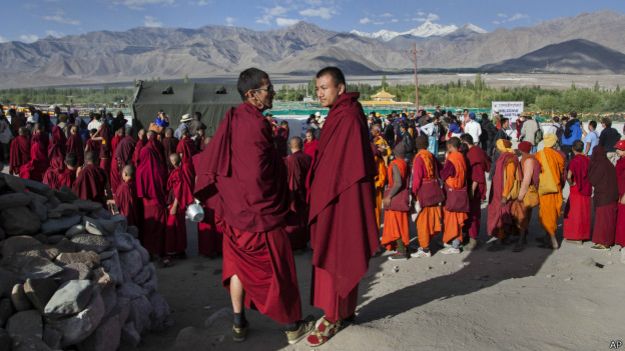
There have been reports that President Xi Jinping is –in relative terms– more tolerant of religion than his predecessors, hoping that this will help fill China's moral vacuum and curb social unrest.
And rumors have long circulated that members of the Chinese elite have been interested in Buddhism., including Xi Jinping's wife, Peng Liyuan.
It is said that the president's own father, Xi Zhongxun, a revolutionary and leader of the Communist Party, He had a good relationship with the Dalai Lama before the latter fled China in 1959.
And that's perhaps where Xiao Wunan comes in., because another unconfirmed rumor says that his father was also close to the president's father.
A lot of this is speculation., of course, But the important question is whether Xiao's permission for the BBC to witness his prayers at a Buddhist altar is intended to send a signal..
up your sleeve
Xiao had another surprise up his sleeve., giving the BBC some video footage of a meeting he had with the Dalai Lama in India –his place of exile– in 2012.
It is unusual evidence of conversations between the Dalai Lama and someone close to the Chinese government.
At one point in the conversation, Dalai Lama tells Xiao he is concerned about activities of fake monks in China.
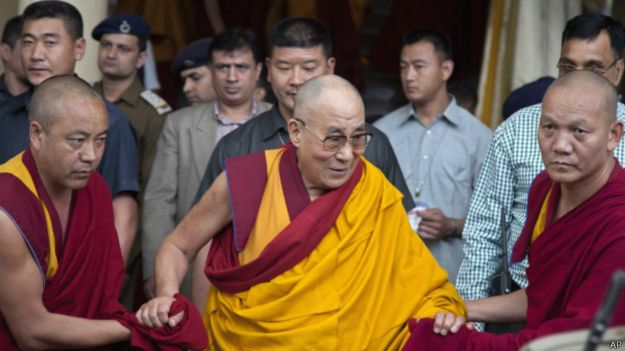
"Yo también estoy preocupado por esto", Xiao responds. "Por lo tanto, estamos realmente necesitados de un líder budista y por eso creo que Su Santidad puede desempeñar un papel tan importante".
At another point in the conversation, The Dalai Lama complains about China's entire approach in Tibet.
"Seamos honestos, el gobierno chino ha estado pensando como un loco en referencia a su política tibetana", dice.
"Esta política de mano dura no es beneficiosa para China o para los tibetanos y también crea una imagen internacional muy mala de China", add.
¿Meaning?
Xiao Wunan's exact role when he was in the government is not very clear. "Solo descríbame como un ex alto funcionario", dice.
He also insists that he was not acting as a Chinese government envoy when he met the Dalai Lama..
He says he was in India, in his capacity as executive vice president of an organization called the Asia Pacific Cooperation and Exchange Foundation (Apecf, by its acronym in English).
Apecf is frequently described as an organization backed by the Chinese government..
either way, It seems unlikely that any former Chinese official would visit the Dalai Lama in India., or allow yourself to be filmed praying before your image, without some very powerful support in Beijing.
So, ¿what could all this mean? I asked Robbie Barnett this question, a Tibet specialist at Columbia University, In New York.
Barnett asks not to look for too much meaning in Xiao Wunan's meeting with the Dalai Lama, but it says it is, at least, symbolic.
"No puedo detectar ninguna actividad políticamente significativa en esa reunión", dice, "pero es importante como indicador simbólico, a vision of a change that could be contemplated in, or about, the highest echelons of the Chinese government.
Karma
There is no doubt that the banning of the Dalai Lama's portrait and the tightening of Chinese control over the past two decades have increased tensions in Tibet..
Throughout that period there have been conversations between the two parties, both formal and informal, but little has changed.
In recent months, however, some reports suggest unofficial dialogue has become more substantial, even raising the possibility that the Dalai Lama will be allowed to return from exile for a historic visit.
So, ¿Should the release of the video by Xiao Wunan be seen as evidence that Xi Jinping is indeed changing China's approach to Tibetan Buddhism, Or is it just a smokescreen??
In any case, Xiao Wunan and his Buddhist oratory appear to be proof that well-connected members of the Chinese elite are taking an active interest in Tibetan Buddhism.. And that the monks are now being given license to encourage them.
"Puede que no sean capaces de comprar su entrada al Nirvana", dice Gueshe Sonam, "pero en el budismo, se puede obtener más recompensa kármica mientras más dinero se gaste en rituales".


