


- This event has passed.
PRESENTATION OF THE BOOK “HIS HOLINESS THE XIV DALAI LAMA. BIOGRAPHY OF A WORK OF ART”
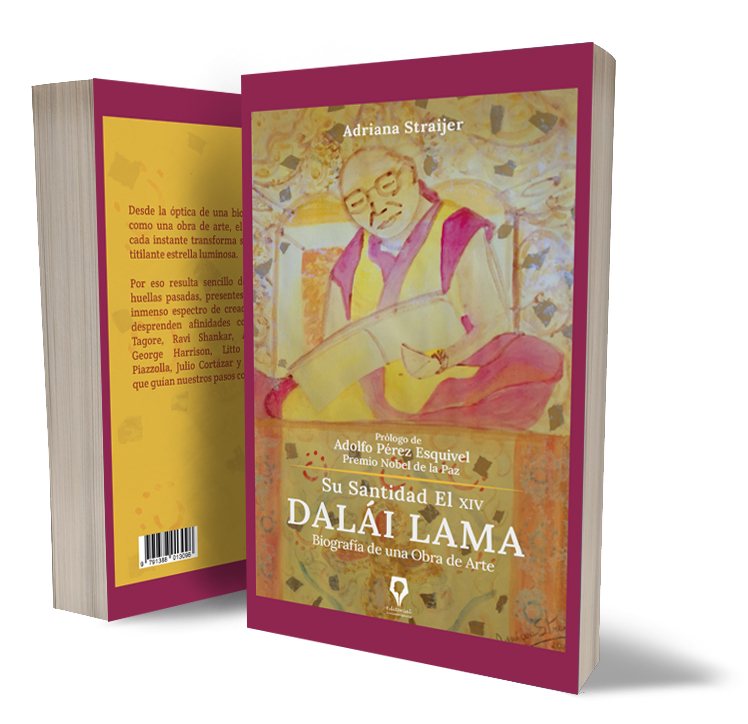
His Holiness the 14th Dalai Lama.
Biography of a Work of Art
Author: Adriana Straijer
Prologue by Adolfo Pérez Esquivel, Nobel Peace Prize
This book by Adriana Straijer proposes an original and deeply humanist approach to the figure of His Holiness the XIV Dalai Lama. This is not a conventional biography, but rather an essayistic and interdisciplinary work that conceives the life of the Tibetan leader as an authentic living work of art, woven by spirituality, the story, the ethics of non-violence and dialogue between cultures.
From the prologue, Adolfo Pérez Esquivel places the work in the context of a world marked by violence, social injustice and the destruction of nature. In that scenario, the Dalai Lama emerges as a universal ethical reference figure, whose message of compassion, shared responsibility and interdependence of all beings becomes more necessary than ever. The book, says Pérez Esquivel, It is a “walk” with the Dalai Lama, an invitation to understand your struggles, hopes and teachings in a troubled world.
An atypical biography
Adriana Straijer, doctor in Contemporary History and specialist in Tibetan Buddhism, states from the beginning that this is a atypical biography. The text is born from years of academic research, but also a vital and aesthetic experience: the author weaves history, anthropology, until, spirituality and memory to offer a holistic reading of the Dalai Lama and the Tibetan people.
The work is structured around what the author calls four fundamental biographical centers of the 14th Dalai Lama:
- His discovery as the reincarnation of the 13th Dalai Lama.
- His enthronement while still a child.
- The flight from Tibet after the Chinese invasion of 1959.
- The exile in India and the subsequent international dissemination of Tibetan Buddhism and the message of peace.
These milestones allow us to understand not only the personal career of the Dalai Lama, but also the historical tragedy of Tibet: the invasion, the genocide of more than a million Tibetans, the destruction of monasteries and the systematic violation of human rights, all this silenced for decades by the international community.
Autobiography, ritual and nonviolence
A central part of the book is dedicated to the analysis of the three autobiographies of the Dalai Lama, addressed as “anthropological doors” that allow access to their inner world, to your spiritual formation and personal evolution. Straijer shows how these autobiographies work concentrically, almost like a mandala, reiterating key episodes from different perspectives.
From an anthropological perspective, The author analyzes the rites of passage of the Dalai Lama: the recognition, the tonsure, monastic clothing, the enthronement and early assumption of political power. These rituals are interpreted as moments of deep transformation, comparable to the great initiatory processes of other spiritual traditions.
On this tour, the figure of the Dalai Lama dialogues with that of Mahatma Gandhi, especially around non-violence, truth and ethical commitment. Straijer draws parallels between both leaders, highlighting how the Dalai Lama adopts and re-signifies non-violence as an active force, capable of confronting even the most oppressive powers without giving up compassion.
The Dalai Lama as a work of art
The second large part of the book develops the most original idea of the work: the Dalai Lama as biography of a work of art. Here, Straijer establishes links between the Tibetan leader and various figures of art and universal culture—filmmakers, musicians, writers and poets—who embody similar values of peace, spiritual search and ethical commitment.
Through these symbolic and real encounters, the Dalai Lama appears as a cultural axis that connects East and West, tradition and modernity, spirituality and artistic creation. Art is presented as a space of resistance, healing and dialogue, capable of transmitting the message of compassion beyond religious or political boundaries.
A universal message
As a whole, His Holiness the 14th Dalai Lama. Biography of a work of art It is a work that transcends mere biographical narration. It is a deep reflection on exile, the identity, spirituality, peace and universal responsibility. The repetition of vital episodes, in the manner of the great oriental epics, reinforces the idea that the figure of the Dalai Lama cannot be exhausted in a single story.
This book invites the reader—and the listener, in a public presentation—to discover that, as the work itself points out, all rivers flow into the sea: the cultures, religions and human searches can meet in the same horizon of dignity, compassion and peace.
Biography Adriana Straijer
Adriana Straijer born in 1956 in San Isidro, Buenos Aires. Has experienced two births, the first in Buenos Aires and the second in Spain, on the island of Mallorca. Between both births, She has been a set designer and costume designer, painter, sculptress, teacher and doctor in Contemporary History dedicated to Tibet.
Buenos Aires has honored her with projects such as Teatro Abierto 81 and the original staging of the play The old servant, by Roberto Cossa, in which she participated as costume designer.
Mallorca has provided light and nature to create sculptures with the stone of its mountains and with elements brought by the sea.. The island of calm has also entrusted him with educational projects for figures such as Joan Miró and Joan Brossa.
Barcelona, For its part, It offered him the spiritual and intellectual framework to approach Tibetan Buddhism and the Dalai Lama..
Currently, his time passes between watercolors, collages, paints, mandalas, research and writing.
FRIDAY 16 JANUARY AT 7PM
INPUT: free entry
INFORMATION: admin@casadeltibetbcn.org / 932075966